


Page 181 - NS-2 Textbook
P. 181
174                                                                                            LEADERSHIP

                                                                    Items most often put at the bottom of any such listing
                                                                 are the threat of disciplinary action, not having to work
                                                                 too hard, and working tmder close supervision. Note that
                                                                 each of these is negative, vvhereas  the nine above are all
                                                                 positive.
                                                                    To  help  motivate "\vorkers,  therefore,  a leader must
                                                                 give each one the chance to  develop his or her abilities
                                                                 and talents. He or she must allow them to use their ini-
                                                                 tiative  and judgment within the  constraints  the  leader
                                                                 sets up.

                                                                                     MORALE

                              Aesthetic needs'                   High morale is the result of effective leadership. No di-
                                symmetry,
                              order, and beauty                  rection of human activity is possible without it, and no
                                                                 failure is final until morale is destroyed. Morale is based
                           Cognitive needs: to know,             on the belief of the leader in the followel; of the follower
                           understand, and explore
                                                                 in the leader, of each in themselves, and of both in the
                          Esteem needs: to achieve, be
                     competent, and gain approval and recognition   cause.
                                                                    What is morale, since it is so important? Morale is ilie
                        Belonging  and love needs: to affiliate   state  of mind of  an individual.  Living conditions, food,
                        with others, be accepted, and belong
                                                                 quarters, discipline, pay, and duties all affect morale. How
                        Safety needs: to feel secure and safe,
                               out of danger                     important a person feels in a group plays a big part in how
                                                                 good or how bad his  or her morale is.  Everything that
                     Phys!o!ogical needs: hunger, thirst, and so forth
                                                                makes a person feel well and satisfied builds up morale,
                                                                 and everything that bothers him or her lowers morale.
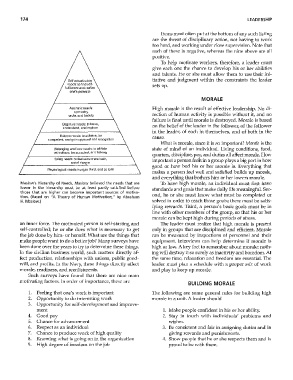
          Maslow's  Hierarchy of Needs.  Maslow believed the needs that are   To have high morale, an individual must first have
          lower  in  the  hierarchy  must  be  at  least  partly  satisfied  before   standards and goals that make daily life meaningful. Sec-
          those  that  are  higher can  become  important  sources  of motiva-
          tion.  (Based  on   II A  Theory  of  Human  Motivation,"  by  Abraham   ond, he or she must know what must be completed or
          H.  Maslow.)                                           solved in order to reach those goals; there must be satis-
                                                                 fying rewards. TIlird, a person's basic goals must be in
                                                                line with other members of the group, so that his or her
                                                                 morale can be kept high during periods of stress.
         an inner force. TIle motivated person is self-starting and   The leader must realize that high morale is present
         self-controlled; he or she  does what is  necessary to get   only in groups that are disciplined and efficient. Morale
         the job done by him- or herself. What are the things that   can be measured by inspections of personnel and their
         make people want to do a better job? Many surveys have   equipment. Interviews can help determine if morale is
         been done over the years to hy to determine these things.   high or low. A key fact to remember about morale: noth-
         In the civilian business world, such matters directly af-  ing will destroy it so surely as inactivity and boredom. At
         fect production, relationships with unions, public good-  the same time, relaxation and freedom are essential. The
         will, and profits. In the Navy, these things directly affect   leader must plan a schedule with a proper mix of work
         morale, readiness, and reenlistrnents.                  and play to keep up morale.
             Such surveys have  fOlmd  that  there  are  nine  main
         motivating factors. In order of inlportance, these are
                                                                                BUILDING  MORALE
             1.  Feeling that one's work is inlportant          The following  are some general rules for building high
             2.  Opportunity to do interesting work             morale in a unit. A leader should
             3.  Opportunity for self-development and inlprove-
                ment                                                 1.  Make people confident in his or her ability.
             4.  Goodpay                                             2.  Stay  in  touch  with individuals'  problems  and
             5.  Chance for advancement                                 vvishes.
             6.  Respect as an individual                            3.  Be consistent and fair in assigning duties and in
             7.  Chance to produce work of high quality                 giving rewards and punishments.
             8.  Knowing what is going on in the organization        4.  Show people that he or she respects them and is
             9.  High degree of freedom on the job                      proud to be with them.

