


Page 178 - NS-2 Textbook
P. 178
APPROACHES TO  LEADERSHIP                                                                            171


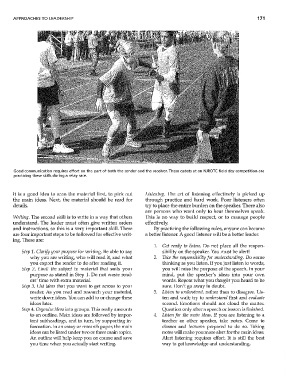
       Good  communication  requires  effort on  the part of both the sender and the receiver.  These  cadets  at an  NJROTC field  day competition  are
       practicing these skills  during a relay race.


      it is a good idea to scan the material first,  to pick out   Listening.  The art of listening effectively is picked up
      the  main  ideas.  Next,  the  material should be  read for   through practice and  hard  work.  Poor listeners  often
       details.                                               try to place the entire burden on the speaker. There also
                                                              are persons who want only to hear themselves speak.
       Writing.  The second skill is to write in a way that others   This  is  no  way to build respect,  or to  manage people
      understand. The leader must often give written orders   effectively.
       and instructions, so this is a very important skill. There   By practicing the following rwes, anyone can become
      are four important steps to be followed for effective writ-  a better listener. A good listener will be a better leader.
      ing. These are:
                                                                 1.  Get  ready  to  listen.  Do not place all  the respon-
          Step 1. Clarifij your purpose for writing. Be able to say   sibility on the speaker. You must be alert!
              'why you are writing, "\vho "'Till read it, and vlhat   2.  Take  the  responsibility for  understanding.  Do some
              you expect the reader to do after reading it.          thinking as you listen. If you just listen to words,
          Step  2.  Limit  the  subject  to  material  that suits  your   you will miss the purpose of the speech. In your
              purpose as stated in Step 1. Do not waste read-        mind,  put  the  speaker's  ideas  into  your  own
              ers' time with extra 11laterial.                       words. Repeat what you thought you heard to be
          Step  3.  List ideas  that you want to get across to your   sure. Don't go away in doubt.
              reader. As  you read and research your material,   3.  Listen  to  understand, rather than to disagree. Lis-
              "\Trite down ideas. You can add to or change these     ten and wait; try to understand first and evaluate
              ideas later.                                           second.  Emotions should not cloud  the  matter.
          Step 4.  Olganize ideas into groups. This really amounts   Question only after a speech or lesson is finished.
              to an outline. Main ideas are followed by impor-   4.  Listen fol'  the  111ail1  ideas.  If you are listening to  a
              tant subheadings, and in tum, by supporting in-        teacher  or  other  speaker,  take  notes.  Come  to
              formation. In an essay or research paper, the main     classes  and  lectures  prepared  to  do  so.  Taking
              ideas can be listed wlder two or tlu'ee rnain topics.   notes will make you more alert for the main ideas.
              An outline ,vill help keep you on course and save      Alert listening requires effort.  It is still the best
              you time 'when you aChtally start writing.             way to get knowledge and lli1derstanding.

