


Page 193 - NS-2 Textbook
P. 193
188                                                                                     NAUTICAL SCIENCES


                                       Aerial view of the U.S,  naval base at Guantanamo Bay,  Cuba.


         state of severe economic depression that has persisted to
         the present day.  This has led several times in the past,
         most recently during the summer of 1994, to large-scale
         attempts at illegal immigration into the United States by
         its population. During these incidents several thousand
         Cuban refugees used makeshift watercraft of all imagin-
         able descriptions to  try to make it across the Straits of
         Florida to land in the southern part of that state. Most of
         them were stopped and rescued from  their often over-
         crowded  and unseaworthy  craft  by  U.s.  Coast  Guard
         and Navy ships and patrol boats. They were then taken
         to  temporary  camps  at  the  Guantanamo  Naval  Base
         pending evenhtal return to Castro's Cuba.
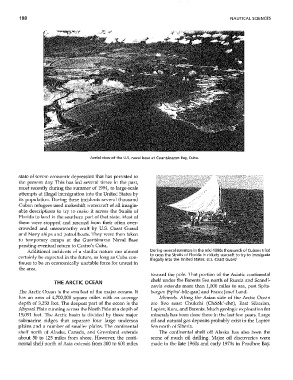
            Additional incidents of a similar nature can almost   During several summers in the mid-1990s thousands of Cubans tried
                                                                to cross the Straits of Florida  in  rickety seacraft to try to immigrate
         certainly be expected in the fuhlre, as long as Cuba con-
                                                                illegally into the United States. u.s.  Coast Guard
         tinues to be an economically unstable force for unrest in
         the area.
                                                                toward the pole. TIlat portion of the Asiatic continental
                                                                shelf under the Barents Sea north of Russia and Scandi-
                        THE ARCTIC OCEAN
                                                                navia  extends more  than 1,000 miles to sea, past Spits-
         The Arctic Ocean is the smallest of the major oceans. It   bergen (Spits' -bur-gan) and Franz Josef Land.
         has  an area  of 4,700,000  square  miles  with an average   Minerals.  Along  the Asian side of the Arctic Ocean
         depth of 3,250 feel.  The deepest part of the ocean is the   are  five  seas:  Chukchi  (Ch06k'-che),  East  Siberian,
         Abyssal Plain I'UlUling across the North Pole at a depth of   Laptev, Kara, and Barents. Much geologic exploration for
         15,091  feel.  The Arctic basin is  divided by tlu'ee  major   minerals has been done there in the last few years. Large
         submarine  ridges  that  separate  four  large  undersea   oil and natural gas deposits probably exist in the Laptev
         plains and a  number of smaller plains. The continental   Sea north of Siberia.
         shelf north of Alaska,  Canada, and Greenland extends      The continental  shelf  off Alaska has  also  been the
         about 50  to 125  nllies  from  shore.  However,  the  conti-  scene  of  much  oil  drilling.  Major  oil  discoveries  were
         nental shelf north of Asia extends from 300 to 600 miles   made in the late 1960s and early 1970s in Prudhoe Bay.

