


Page 197 - NS-2 Textbook
P. 197
192                                                                                     NAUTICAL SCIENCES


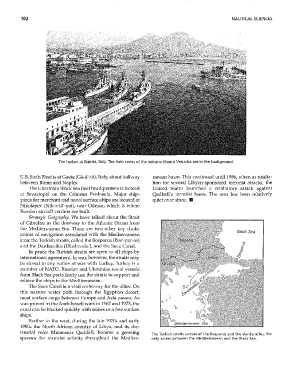
                          The harbor at Naples,  Italy.  The twin cones of the volcano Mount Vesuvius are in the background.


         u.s. Sixth Fleet is at Gaeta (G1H't'-ta), Italy, about halfway   ranean basin. This continued lmtil1986, when in retalia-
         between Rome and Naples.                                tion  for  several Libyan-sponsored  terrorist  attacks,  the
             The Ukrainian Black Sea fleet headquarters is located   United  States  lalmched  a  retaliatory  attack  against
          at  Sevastopol  on  the  Crimean  Peninsula.  Major  ship-  Qadhafi's  terrorist bases.  The  area  has  been relatively
          yards for merchant and naval surface ships are located at   quiet ever since.  II
          Nikolayev (Nik-a-Hi'-yaf), near Odessa, which is where
          Russian aircraft carriers are built.
             Strategic  Geography.  We have talked about the Strait
          of Gibraltar as  the dOOlway to the Atlantic Ocean from
          the Mediterranean Sea.  There  are  two  other key  choke
          points of navigation associated with the Mediterranean
          area: the Turkish straits, called the Bosporus (Bos'-per-as)
          and the Dardanelles (Dard-n-elz'), and the Suez Canal.
             In peace the Turkish straits are open to all ships by
         international agreement. In 'Va1~ h01vever, the straits may
         be closed to  any nation at war with Turkey. Turkey is a
          member of NATO. Russian and Ukrainian naval vessels
         from Black Sea ports freely use the straits to support and
          relieve the ships in the Mediterranean.
             The Suez Canal is a vital waterway for the allies. On
          this  narrow  water  path  through  the  Egyptian  desert,
         most surface cargo between Europe and Asia passes. As
         was proved in the Arab-Israeli wars in 1967 and 1973, the
         canal can be blocked quickly with mines or a few sunken
         ships.
             Farther to  the west, during the late 1970s and early
         1980s  the  North African  cOlmtry  of Libya,  and its  dic-
          tatorial  ruler  Muamrnar  Qaddafi,  became  a  growing   The Turkish  straits consist of the Bosporus and the Dardanelles, the
         sponsor  for  terrorist  activity  throughout  the  Mediter-  only access between the Mediterranean and the Black  Sea.

