


Page 21 - NS-2 Textbook
P. 21
14                                                                                      MARITIME HISTORY


           in the Continental Navy, John Paul Jones. More would be   money to pay those who were left. It was nearly impos-
           heard of him later.                                    sible to recruit men for such duty, when the crews of the
              In February 1776 Congress directed Hopkins to take   coastal privateersmen got better shares of the prizes they
           his squadron to the Virginia Capes to neutralize any loy-  captured plus quick payoffs for their efforts.
           alist craft he might find there. But in keeping with his in-  TIms, the Nassau expedition tumed out to be the last
           dependent New England spirit, once at sea, Hopkins de-  time American ships would put to sea as a squadron dur-
           cided to go after bigger game. He sailed straight for New   ing the "var.  Later, various officers who had been in the
           Providence (later Nassau) in the Bahamas, where he was   squadron set out by themselves in their ships and took
           able to overcome two  British forts  and take more than   on many British ships in hard-fought individual actions.
           eighty artillery pieces, powder, and naval stores.         One  such  officer  was  Lieutenant Jolm  Paul Jones.
              On their way home, the squadron captured several    With his sloop the Pl'Ovidel1Ce, in a single month, August
           British ships loaded with more British arms, which they   1776, he captured sixteen enemy vessels and destroyed
           took to Washington's troops as well. The expedition was   many others. Later, as captain of the makeshift frigate Al-
           not without casualties, however. Just after midnight on 5   fred, Jones cruised off the New England coast and raided
           April,  the  squadron  happened  upon  the  twenty-glill   enemy shipping and fishing in that area. One of the ships
           British corvette Glasgow off New England. After damag-  he captrn"ed  carried  British  winter  uniforms,  and  soon
           ing many of the squadron's ships, the Glasgow  escaped,   10,000 American soldiers were wearing them. John Paul
           even though she 'was ouh1tunbered six to one.          Jones  would become legendary among early American
              This  incident showed  in many ways what kind of    naval leaders.
           navy  the  Continental  Congress  had  gathered.  For  the
           most  part,  the  squadron  captains  were  privateerSlllen
           who could not cooperate with each other, teach their men       THE  BATILE OF LAKE  CHAMPLAIN
           glmnery,  or maintain  squadron  discipline.  One  of  the
           captains, Tom Hazard of the sloop Providence,  was dis-  In the fall of 1775, the American Patriots under General
           missed for  cowardice, and his  ship was given to  Lieu-  Benedict Arnold attacked  Quebec  in Canada,  but they
           tenant Jones.                                          could  not capture  the  city.  The  Americans  stayed  and
               A few weeks latel; when Hopkins took the squadron   bombarded the  city through the  winter.  In  the  spring,
           south  to  Providence,  Rhode  Island,  troubles  began  to   when the ice melted on the St. Lawrence River, British re-
           multiply.  Several of the ships began to break down, an   inforcements arrived by ship, forcing  the Patriots to re-
           epidemic of smallpox sent a hundred men ashore,  and   treat toward the colonies. The British, under Generals Sir
           General Washington  wanted  another hundred  men he    Guy Carleton and John Burgoyne, pursued them.
           had  loaned  to  the  squadron  returned.  There  was  no   When Arnold and his men reached Lake Champlain
                                                                  in Jlme  1776,  he  assembled  a  ragtag  flotilla  of  sixteen
                                                                  craft. In response the British constructed their own naval
                                                                  force,  and  by  October,  they  were  ready  to  proceed
                                                                  against the Americans.
                                                                      Strength was not on Arnold's side, but he outfoxed
                                                                  the British. At Valcour Island  on 11  October he hid his
                                                                  flotilla until the enemy fleet sailed past before a strong
                                                                  north  wind.  Then  the  American  force  attacked  from
                                                                  upwind, forcing the British to turn and attack against the
                                                                  wind.  Over the next two days  the Americans inflicted
                                                                  much damage on the superior British fleet,  though they
                                                                  lost most of their  ships  in  the  process.  Afterward  the
                                                                  Alnericans  ran  their  £e",T  surviving  craft  ashore  and
                                                                  burned them, then escaped into the woods. By this time
                                                                  winter was approaching, and Carleton had to return to
                                                                  winter quarters in Canada.
                                                                      This action could not be considered a "victory!; in the
                                                                  usual sense because Arnold lost all his ships. Howevel;
                                                                  the Patriots were able to stop  the southerly British ad-
                                                                  vance  and  thus  gain  time  to  regroup  and  train  their
                                                                  forces until the following spring.
                                                                      Meanwhile,  the  Second  Continental  Congress  had
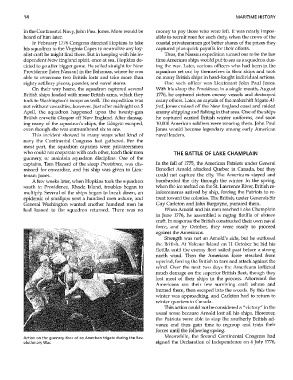
           Action on the gunnery deck of an American frigate during the Rev-
           olutionary War.                                        signed the Declaration of Independence on 4 July 1776,

