


Page 249 - NS-2 Textbook
P. 249
244                                                                                     NAUTICAL SCIENCES


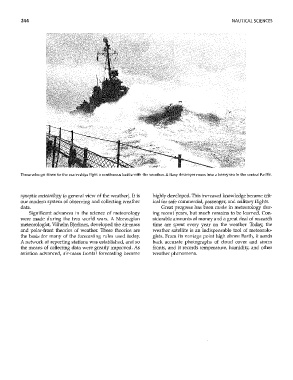
          Those who go down to the sea in ships fight a continuous battle with the weather. A Navy destroyer noses into a heavy sea in the central Pacific.


          synoptic meteoroiogJj (a general view of the weather). It is   highly developed. This increased knowledge became crit-
          our modern system of observing and collecting weather   ical for safe commercial, passenger, and military ilights.
          data.                                                      Great progress has been made in meteorology dur-
             Significant  advances in the  science  of meteorology   ing recent years, but much remains to be learned. Con-
          were  made  during  the  two  world wars.  A Norwegian   siderable ammmts of money and a great deal of research
          meteorologist, Vilhelm Bjerknes, developed the air-mass   time  are  spent  every  year  on  the  weather.  Today,  the
          and polar-front theories  of weather.  These  theories  are   weather satellite is an indispensable tool of meteorolo-
          the basis for many of the forecasting rules  used today.   gists. From its vantage point high above Earth, it sends
          A network of reporting stations was established, and so   back  accurate  photographs  of  cloud  cover  and  storm
          the means of collecting data were greatly improved. As   fronts,  and it records temperature, hwnidity, and other
          aviation advanced,.  air-mass  frontal  forecasting became   weather phenomena.

