


Page 252 - NS-2 Textbook
P. 252
METEOROLOGY                                                                                           247


                         IONOSPHERE                           posed of three atoms of oxygen per molecule (rather than
                                                              the two in a normal oxygen molecule), absorbs the ultra-
       Above  the  stratosphere  lies  an  area  of  electrically
                                                              violet rays.
       charged particles called ions.  This ionosphere begins per-
                                                                  There has been much concern in recent years that the
       haps as low as 30 or 40 miles up and extends to about 500
                                                              ozone layer is being slowly depleted by fluorocarbon gas
       miles. Disturbances on the Sun, such as sunspots, change
                                                              reacting with the ozone. Fluorocarbons have been widely
       the ionosphere's form, and it is turbulent with magnetic
                                                              used as propellants in aerosol cans for such products as
       and  electrical  storms.  It is  in  the  ionosphere  that  the
                                                              hair spray and spray paint, and also as refrigerants in air
       Northern Lights create their colorful display.
                                                              conditioning systelns in cars, homes, and businesses. As
          It is possible to  send ordinary radio waves around
                                                              a  result of tlns  dangel; many spray can and air condi-
       the world by bouncing  them off ionospheric  layers.  In
                                                              tioning  manufacturers  in  the  United  States  and  else-
       other words, the ionosphere will reflect radio waves of
                                                              where have switched to other substances, but these alter-
       certain frequencies. By determining the best frequencies
                                                              natives  tend  to  be  nlore  expensive.  Fluorocarbons  are
       and times of day to transmit them, communications are
                                                              also released by the burning of styrofoam.
       greatly enhanced. This phenomenon is one with which
       every Navy and ham radio operator is familiar.
          The  mesosphere,  the lowest level  of the ionosphere,                 EXOSPHERE
       extends from about 30 to 50 miles above the Earth. nris
                                                              The  topmost layer or outer fringe  of the atmosphere is
       layer is one of extreme temperature changes. At the low-
                                                              called the exosphere. It begins about 500 uriles above the
       est part of the layer the temperature may be as high as 32   Earth's surface and continues out to about 18,000 miles.
       degrees F. But it will drop to below -100 degrees F at the
                                                              Only the light hydrogen and helium atoms exist in the
       mesosphere'S upper limits. It will then start to rise again
                                                              area-in atomic form because of the intense cosmic radi-
       above 70 miles, as one moves into the thermosphere.
                                                              ation. Temperatures may be as high as 4,500 degrees F in
          The  thermosphere  is  the  highest  level  of  the  iono-
                                                              daylight and may drop to near absolute zero (-460 de-
       sphere. The air is extremely thin and the particles are ion-
                                                              grees F) at night.
       ized, or electrified, by loss of their electrons. This ioniza-
                                                                  Within the exosphere are the intense radiation areas
       tion is caused by the constant bombardment of cosmic
                                                              called  the  Vall  Allen  radiation  belts.  These  belts encircle
       rays from outer space. It is in the thermosphere that the
                                                              Earth in  two  segments.  One  is  about 400-3,400  miles
       principal radio-reflecting layers of the ionosphere are lo-  above  Earth,  while  the  outer belt  extends  from  about
       cated.  Extremely high temperatures exist in this  layer.
                                                              8,000-40,000  miles  out.  The  inner  belt  contains  high-
       Recent information shows that temperatures in the ther-
                                                              energy protons, and the outer belt contains high-energy
       mosphere can approach 1,700 degrees F at a 300-mile al-  electrons.  Manned  space  missions  are  intentionally
       titude.                                                flown  well  beneath the  lower limits  of  the  Van  Allen
           Another very important transition zone  within the
                                                              belts,  and satellites  operating in these  regions  must be
       broad ionospheric region, but actually starting well below   shielded  against  the  radiation  encotmtered  there.  The
       it, is the citel110spilere or ozone layer. Beginning at an alti-
                                                              exosphere is the end of our air ocean. Beyond it is outer
       tude of about 15 miles, this layer shields Earth from the
                                                              space.
       harmful ultraviolet rays of the Sun.  Ozone,  a  gas  com-
                                                                          ATMOSPHERIC PRESSURE
                                                              The layer of atmosphere that surrounds us exerts a pres-
                                                              sure of nearly 15 pounds per square inch (14.696 psi, or
                                                                         5
                                                              about 1 x 10 Pascals) at sea level. The weight of the at-
                                                              mosphere varies from place to place, depending on the
                                                              amount of water vapor present, the temperature, and the
                                                              height above Earth's surface.  Variations  in  atmospheric
                                                              pressure are measured by a baroilleter.
                                                                  The Navy uses  two  types  of barometers:  mercurial
                                                              and  aneroid.  Usually  the  aneroid  type  is  employed
                                                              aboard ship. The mercurial type consists of a calibrated
                                                              glass tube filled with mercury. It is used at shore activi-
                                                              ties  to  check  aneroid  barometers  for  accuracy.  The
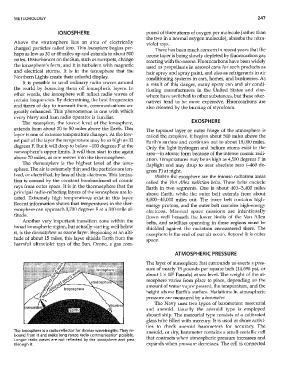
       The ionosphere is a radio reflector for shorter wavelengths. They re-  aneroid} or dry, barometer contains a small metallic cell
       bound from  it and make long-range radio communication possible.
       Longer  radio waves  are  not  reflected  by  the  ionosphere  and  pass   that contracts ·when atnlospheric pressure increases and
       through  it.                                           expands when pressure decreases. The cell is connected

