


Page 244 - NS-2 Textbook
P. 244
OCEANOGRAPHY                                                                                          239


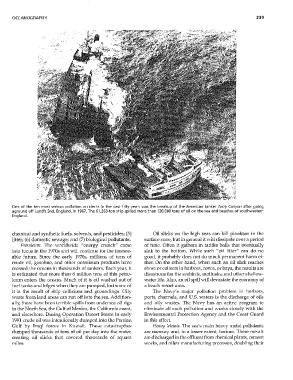
      One  of the ten  most serious  pollution  accidents  in  the  past  fifty years was the  breakup  of the American tanker  Torry  Canyon  after going
      aground off Land's  End,  England,  in  1967. The 61,263-ton ship spilled more than 120,000 tons  of oil on the sea  and  beaches of southwestern
      England.


      chemical and synthetic fuels, solvents, and pesticides; (5)   Oil  slicks on the high seas can kill plankton in the
      litter; (6) domestic sewage; and (7) biological pollutants.   surface zone, but in general it will dissipate over a period
          Petroleum.  The  ,vorld-wide  Uenergy  crunch"  Canl€   of time.  Often it gathers in tarlike balls that eventually
      into focus in the 1970s and will continue for the foresee-  sink  to  the  bottom.  While  such  "oil  litter"  can  do  no
      able  future.  Since  the  early  1970s,  millions  of  tons  of   good, it probably does not do much permanent harm ei-
      crude oil,  gasoline, and other petroleum products have   ther.  On the other hand, when such an oil slick reaches
      crossed the oceans in thousands of tankers. Each yea,; it   shore or collects in harbors, coves, or bays, the results are
      is estimated that more than 6 million tons of this petro-  disastrous for the seabirds, mollusks, and other shallow-
      leum enters the oceans. Much of it is oil washed out of   water life. Also, an oil spill will devastate the economy of
      fuel tanks and bilges when they are pmnped, but some of   a beach resort area.
      it is  the  result  of  ship  collisions  and groundings.  Oily   The  Navy's  major  pollution  problem  in  harbors,
      waste from land areas can run off into the sea. Addition-  ports, channels, and U.S.  waters is the discharge of oils
      ally, there have been terrible spills from lmdersea oil rigs   and  oily  wastes.  TIle  Navy  has  an  active  program  to
      in the North Sea, the Gulf of Mexico, the California coast,   eliminate all such pollution and works closely with the
      and elsewhere. During Operation Desert Storm in early   Enviromnental Protection Agency and the Coast Guard
      1991 crude oil was intentionally dlunped into the Persian   in this effort.
      Gulf  by  Iraqi  forces  in  Kuwait.  These  catastrophes   Heavy Metals.  The sea's main heavy metal pollutants
      dumped thousands of tons of oil per day into the water,   are mercury and, to a lesser extent, bariwn. These metals
      creating  oil  slicks  that  covered  thousands  of  square   are discharged in the effluent from memical plants, cement
      miles.                                                 works, and other manufacturing processes, doubling their

