


Page 259 - NS-2 Textbook
P. 259
254                                                                                     NAUTICAL SCIENCES


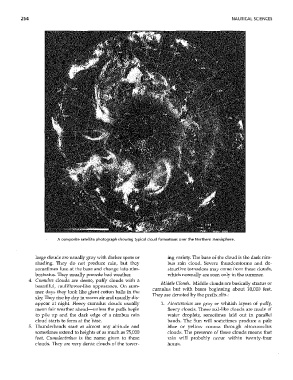
                         A composite satellite photograph showing typical cloud  formations over the Northern Hemisphere.


                large clouds are usually gray with darker spots or     ing variety. The base of the cloud is the dark ninl-
                shading.  They  do  not  produce  rain,  but  they     bus  rain  cloud.  Severe  thunderstorms  and  de-
                sometimes fuse at the base and change into nim-        structive tornadoes may come from these clouds,
                bostratus. TIley usually precede bad weather.          which normally are seen only in the Slffilffier.
             4.  Cumulus  clouds are  dense, puffy clouds with a
                                                                    Middle Clouds.  Middle clouds are basically strahlS or
                beautiful, cauliflower-like  appearance.  On sum-
                                                                 cumulus  but  with  bases  beginning  about  10,000  feet.
                mer days they look like giant cotton balls in the
                                                                 They are denoted by the prefix 0110-:
                sky. TIley rise by day in warm air and usually dis-
                appear at night.  Fleecy  cumulus clouds  usually   1.  Altocumulus  are  gray or whitish layers of puffy,
                mean fair weather ahead-unless the puffs begin         fleecy clouds. These roll-like clouds are made of
                to  pile  up  and  the  dark edge of a  nimbus rain    water  droplets,  sometimes  laid  out  in  parallel
                cloud starts to form at the base.                      bands.  The  Sun will  sometimes produce a  pale
             5.  Thlmderheads  start  at  aimost  any  altitude  and   blue  or  yellow  corona  through  altocumulus
                sometimes extend to heights of as much as 75,000       clouds. TI,e presence of these clouds means that
                feet.  Cumulonimbus  is  the  name  given  to  these   rain  will  probably  occur  within  twenty-four
                clouds. They are very dense clouds of the tower-       hotu's.

