


Page 256 - NS-2 Textbook
P. 256
METEOROLOGY                                                                                          251


                                                                            IF THE AIR  COULD  HOLD
                      [00 0   2[2 0   BOILING  POINT                         THIS  MUCH  MOISTURE
                                 OF  WATER
                                                                                  .-.•..
                                                                                   ••••
                      90     194                                                  .•. -.-
                      80     176
                                                                                   .. ,-
                                                                                  0  .. •  ••
                      70     158
                                                                              AS  WATER  VAPOR
                      60     140                                            AT THIS TEMPERATURE   GooF
                      50     122~                                      BEFORE THE  MOISTURE  BEGAN
                                                                       TO  RILL  OUT AS  RAIN, SNOW,
                    (/)40    I04W                                                 ETC.
                    2          :J:
                    (/)30   86  Z                                                 THEN-
                    ...J       W
                    ~20     68 a::                                         THE  RELATIVE  HUMIDITY
                               :c
                                                                             OF THE  AIR WOULD
                            50 Lt                                             BE  100 PERCENT
                      10
                        0
                       0    32° MELTING  POINT
                               Of  ICE
                                                                          BUT THE AIR  NOW  HOLDS
                      -10   14                                               HALF  THAT MUCH
                                                                                MOISTURE
                     -20    -4
                                                                                  • •
                     -30    -22                                                  ••••
                     .40 0   _40 0                                                   •
                                                                                • ••  •
                                                                                  ••
                                                                       AT  THE  SAME  TEMPERATURE   6O"F
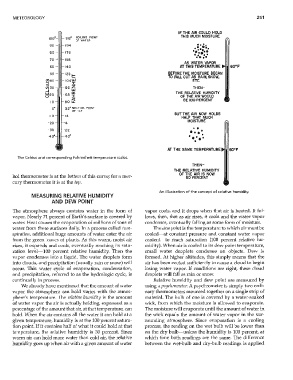
        The Celsius and corresponding Fahrenheit temperature scales.
                                                                                 THEN-
                                                                          THE  RELATIVE  HUMIOITY
                                                                            OF THE  AIR  IS  NOW
      hal thermometer is at the bottolll of this curve; for a mer-             50 PERCENT
       cury thermometer it is at the top.
                                                                    An illustration of the concept of relative humidity.
              MEASURING RELATIVE  HUMIDITY
                       AND DEW POINT
      The atmosphere  alvvays  contains V\Tater  in  the  form  of   vapor cools, and it drops when that air is heated. It fol-
       vapor. Nearly 71 percent of Earth's surface is covered by   lows, then, that as air rises, it cools and the water vapor
      vlater. Heat causes the evaporation of millions of tons of   condenses, eventually falling as some form of moisture.
      water from these surfaces daily. In a process called tran-  The dew poi1lt is the temperature to which air must be
      spiration, additional huge amounts of water enter the air   cooled-at constant pressure and constant water vapor
      from the green leaves of plants. As this \Varnl, moist air   content-to  reach  sahuation  (100  percent  relative  hu-
      rises} it expands and cools, evenhmlly reaching its satu-  midity). When air is cooled to its dew point temperature,
       ration  level-lOa  percent  relative  humidity.  Then  the   small  water  droplets  condense  on  objects.  Dew  is
      vapor condenses into a liquid. The water droplets form   formed. At higher altihldes, this simply means that the
       into clouds, and precipitation (usually rain or snow) will   air has been cooled sufficiently to cause a cloud to begin
      occur.  This  "",rater  cycle  of  evaporation,  condensation,   losing ,vater vapor. If conditions are right, these  cloud
       and precipitation, referred to as the hydrologic cycle, is   droplets ,vill fall as rain or snmN.
       continually in process.                                   Relative humidity and dew point are measured by
          We already have mentioned that the amount of water   using a psychrometer. A psychrometer is simply two orcli-
      vapor the  ahnosphere  can hold varies  with the  ahnos-  nary thermometers mounted together on a single strip of
      phere's temperahue. The relative hUlIlidity is the amount   material. The bulb of one is  covered by a water-soaked
       of water vapor the air is aChlally holding, expressed as a   V\Tick,  from  which the moisture is alloV\Ted  to evaporate.
      percentage of the amount that air, at that temperahue, can   TIle moishue will evaporate until the amount of water in
      hold. When the air contains all the water it can hold at a   the wick equals the  amount of water vapor in the sur-
       given temperature, hmniclity is at the 100 percent satura-  rounding  ahnosphere.  Since  evaporation  is  a  cooling
       tion point. If it contains half of what it could hold at that   process, the reading on the wet bulb will be lower than
       temperature,  the  relative  humidity is  50  percent.  Since   on the dry bulb-unless the humidity is 100 percent, at
       warm air can hold more ""vater than cold all~ the relative   which time both readings are  the same.  The  difference
      htunidity goes up when ail' with a given amount of water   between the wet-bulb and dry-bulb readings is applied

