


Page 255 - NS-2 Textbook
P. 255
250                                                                                     NAUTICAL SCIENCES


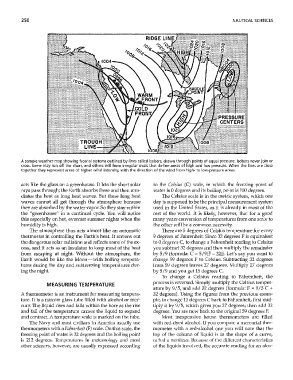
          A sample weather map showing frontal systems outlined by lines called isobars,  drawn through points of equal pressure. Isobars never join or
          cross.  Some  may run  off the chart, and others will form irregular ovals  that define areas of high and low pressure.  When the lines are dose
          together they represent areas of higher wind intensity, with the direction  of the wind from  high- to low-pressure areas.


          acts like the glass on a greenhouse. It lets the short solar   to  the  Celsius  (C)  scale,  in which  the  freezing  point of
          rays pass through; the Earth absorbs these and then rera-  water is 0 degrees and its boiling point is 100 degrees.
          diates the heat as long heat waves. But these long heat    The Celsius scale is in the metric system, which one
          waves  cannot  all  get through  the  atmosphere  because   day is supposed to be the principal measurement system
          they are absorbed by the water vapor. So they stay within   used in the United States, as it is already in most of the
          the  If greenhouse"  in  a  continual cycle.  You  ,vill notice   rest of the world. It is likely, howevel;  that for  a  good
          this especially on hot, overcast sununer nights when the   many years conversion of temperatures from one scale to
          humidity is high.                                      the other will be a conunon necessity.
              The atmosphere thus acts  almost like an automatic     There are 5 degrees of Celsius temperature for every
          thermostat in controlling the Earth's heat. It screens out   9 degrees of Fahrenheit. Since 32 degrees F is equivalent
          the dangerous solar radiation and reflects some of the ex-  to 0 degrees C, to change a Fahrenheit reading to Celsius
          cess, and it acts as an insulator to keep most of the heat   you subtract 32 degrees and then multiply the remainder
          from  escaping  at  night.  Without  the  atmosphere,  the   by 5/9 (formula: C = 5/9[F - 32]). Let's say you want to
          Earth would be like  the Moon-with boiling tempera-    change 59  degrees F  to  Celsius.  Subh'acting 32  degrees
          tures during the day and subfreezing temperatures dur-  from 59 degrees leaves 27 degrees. Multiply 27 degrees
          ing the night.                                         by 5/9 and you get 15 degrees C.
                                                                     To  change  a  Celsius  reading  to  Fahrenheit,  the
                                                                 process is reversed. Sinlply multiply the Celsius temper-
                     MEASURING TEMPERATURE
                                                                 ature by 9/5, and add 32 degrees (formula: F =  9/5 C +
          A thermometer is an instrument for measuring tempera-  32 degrees).  Using the figures from the previous exam-
          ture. It is a narrow glass tube filled with alcohol or mer-  ple, to change 15 degrees C back to Fahrenheit, first mul-
          cury. The liquid rises and falls within the bore as the rise   tiply it by 9/5, which gives you 27 degrees; then add 32
          and fall  of the temperature causes the liquid to expand   degrees. You are now back to the original 59 degrees F.
          and contract. A temperature scale is marked on the hibe.   Most  inexpensive  house  thermometers  are  filled
              The Navy and most civilians in America usually use   with red-dyed alcohol. If you compare a mercurial ther-
          thermometers with a Fahrenheit (F) scale. On that scale, the   mometer with a  red-alcohol  one you will note that the
          freezing point of water is 32 degrees and the boiling point   top of the cohunn of liquid is in the  shape of a  curve,
          is  212  degrees.  Temperatures  in meteorology  and most   called a meniscus. Because of the different characteristics
          other sciences, however, moe  usually expressed according   of the liquids involved, the accurate reading for an alco-

