


Page 282 - NS-2 Textbook
P. 282
METEOROLOGY                                                                                           277

                                            C)rV'  n-'O  ~I(..  ~IO   r?CO   r?'(...
                                           '"   ,()  ,C)  ,0   ,C)   ,tJ
                                            5


                                    ............ _  ....... _  ..... "- cold front   '----e-  -~
                                                                            west wind-cloudy   east wind---'{;lear
                                    ...... ·"-......... "-...... ·IIL warm front   arrows point with wind:
                                    ,  ." •   ...  •   stationary front   @   0-- 0--,. O-,p-~o-----..~
                                                               calm, clear   1.2   3-8   9·14  15.20' 21-25 26-31
                        o  G  •    ®  ®  ®  ®         §          ~~~~~~~~
                       clear   \  cloudy  I  sncm.1   rep'o~   hurricane
                         partly ctoudy   rain   fog   missing    32-37  38-43  44·49  50·54 55·60 61·66  67·71  72-77
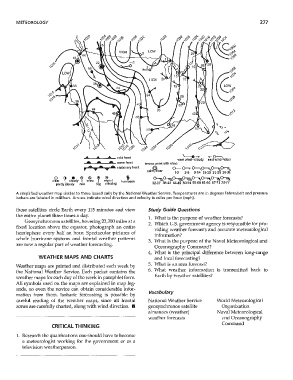
        A simplified weather map similar to those issued daily by the National Weather Service. Temperatures are in degrees Fahrenheit and pressure
        isobars are labeled in millibars. Arrows indicate wind direction and velocity in miles per hour (mph).

        these satellites circle Earth every 115 minutes and view   Study Guide Questions
        the entire planet three times a day.
                                                               1.  What is the purpose of weather forecasts?
            Geosynchronous satellites, hovering 22,300 miles at a
                                                               2.  Which U.S. government agency is responsible for pro-
        fixed  location above the equator, photograph an entire
                                                                  viding weather forecasts and accurate meteorological
        hemisphere every half an hour.  Spectacular pictures of
                                                                  information?
        whole  hurricane systems and  frontal  weather patterns
                                                               3.  What is the purpose of the Naval Meteorological and
        are now a regular part of weather forecasting.
                                                                  Oceanography Command?
                                                               4.  What is  the principal difference between long-range
                 WEATHER MAPS AND CHARTS                          and local forecasting?
                                                               5.  What is an area forecast?
        Weather maps are printed and distributed each week by
                                                               6.  What  weather  information  is  transmitted  back  to
        the National Weather Service. Each packet contains the
                                                                  Earth by weather satellites?
        weather maps for each day of the week in pamphlet form.
        All symbols used on the maps are explained in map leg-
        ends, so even the novice can  obtain  considerable  infor-
                                                               Vocabulary
        mation  from  them.  Isobaric  forecasting  is  possible  by
        careful  reading  of  the  weather  maps,  since  all  frontal   National Weather Service   World Meteorological
        zones are carefully charted, along with wind direction.  III   geosynchronos satellite   Organization
                                                               almanacs (weather)           Naval Meteorological
                                                               weather forecasts              and Oceanography
                                                                                              Command
                       CRITICAL THINKING
        1.  Research the qualifications one should have to become
           a meteorologist working for  the  govenunent or  as  a
           television weatherperson.

