


Page 281 - NS-2 Textbook
P. 281
276                                                                                     NAUTICAL SCIENCES


                                                                for the year ahead; these are based on average weather
                                                                reported for years past.
                                                                    Local weather is predicted up to a month or so in ad-
                                                                vance.  The  accuracy  of  these predictions  is  dependent
                                                                upon timely readings taken at many reporting stations-
                                                                on land  and  by weather  ships,  balloons,  and weather
                                                                satellites. While forecasting is becoming much more ac-
                                                                curate, it still is not an exact science, due to the wide va-
                                                                riety of local atmospheric uncertainties.
                                                                    In the Navy elements of the Naval Meteorological
                                                                and Oceanography Command prepare several  types of
                                                                forecasts, each for a specific purpose and containing spe-
                                                                cific information.
                                                                    Area forecasts  are prepared by major units afloat and
                                                                ashore.  The  area  covered is the  If operating area"  of the
                                                                major  units.  Area  forecasts  will  include  a  synopsis  of
                                                                weather conditions in the forecast area. They will report
                                                                all  pressure  systems  and  their  associated  ·weather,  in-
                                                                cluding the system's position, intensity, and direction of
                                                                movement. Intensity will include wind direction and ve-
                                                                locity, visibility, and weather types. Position will always
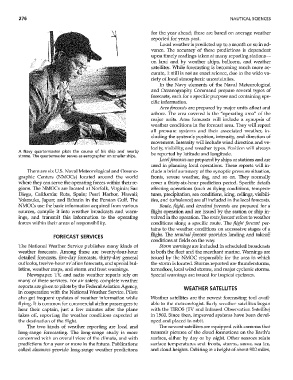
         A  Navy  quartermaster  plots  the  course  of  his  ship  and  nearby
         storms. The quartermaster serves as aerographer on smaller ships.   be reported by latitude and longitude.
                                                                    Local forecasts are prepared by ships or stations and are
                                                                used in planning local operations. These reports will in-
            There are six U.s. Naval Meteorological and Oceano-  clude a brief summary of the synoptic pressure situation,
         graphic  Centers  (NMOCs)  located  around  the  world   fronts,  severe  "veather,  fog,  and  so  on,  They  normally
         where they can serve the operating forces within their re-  cover a  thirty-six-hour prediction period. Specific details
         gions. The NMOCs are located at Norfolk, Virginia; San   affecting operations (such as flying conditions, tempera-
         Diego,  California;  Rota~ Spain;  Pearl  Harbor,  Hawaii;   tw'es, precipitation, sea conditions, icing, ceilings, visibili-
         Yokosuka, Japan; and Bahrain  in the Persian Gulf. The   ties, and turbulence) are all included in the local forecasts.
         NMOCs use the basic information acquired from various      ROllte, flight,  and terminal forecasts  are prepared for a
         sources,  compile it into  weather broadcasts  and  \varn-  flight operation and are issued by the station 01' ship in-
         ings,  and  transmit  this  information  to  the  operating   volved in the operation. The rOllte forecast refers to weather
         forces within their areas of responsibility.           conditions  along  a  specific  route.  The flight forecast  per-
                                                                tains to the weather conditions on successive stages of a
                                                                flight.  TIle  termillal forecast  provides landing and takeoff
                       FORECAST SERVICES
                                                                conditions at fields on the way.
         The National Weather Service publishes many kinds of       Storm wal'1lings are included in scheduled broadcasts
         weather  forecasts.  Among  these  are  twenty-four-hour   to both the fleet and the merchant marine. Warnings are
         detailed forecasts, five-day forecasts,  thirty-day general   issued by the NMOC responsible for  the area in which
         outlooks, twelve-hour aviation forecasts, and special bul-  the stornl is located. Storms reported are thunderstorms,
         letins, weather maps, and storm and frost warnings.    tornadoes, local wind storms, and major cyclonic storms,
            Newspaper, TV,  and radio weather reports rely on   Special warnings are issued for tropical cyclones.
         many of these services. For air safety, complete weather
         reports are given to pilots by the Federal Aviation Agency,
                                                                              WEATHER  SATELLITES
         in cooperation with the National Weather Service. Pilots
         also get frequent updates of weather information while   Weather satellites are the newest forecasting tool avail-
         flying. It is common for commercial airline passengers to   able to the meteorologist. Early weather satellites began
         hear  their  captain,  just  a  few  minutes  after  the  plane   with the TIROS  (TV  and Infrared Observation Satellite)
         takes  off,  reporting the weather conditions expected at   in 1960. Since then, improved systems have been devel-
         the destination of the flight.                         oped and placed in orbit.
            The  two  kinds  of weather reporting are  local  and   The newest satellites are equipped with cameras that
         long-range  forecasting.  The  long-range  study  is  more   transmit pictures of the cloud formations on the Earth's
         concerned with an overall view of the climate, and with   surface, either by day or by night. Other sensors relate
         predictions for a year or more in the future. Publications   surface  temperatures  and fronts,  storms,  snmv,  sea  ice,
         called almallacs  provide long-range weather predictions   and cloud heights. Orbiting at a height of about 900 miles,

