


Page 335 - NS-2 Textbook
P. 335
330                                                                                      NAUTICAL SCIENCES


                                                                     I  =  current in amperes
                                                                     E  =  voltage in volts
                                                                     R  =  resistance in ohms
                                                                 If any two of the quantities in the equation are known,
                                                                  the third may be easily found.

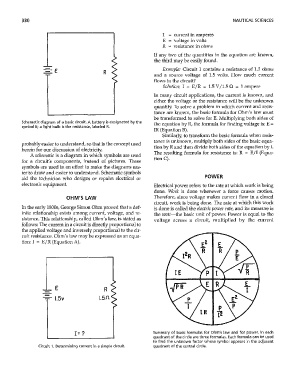
                        E                   R                        Example:  Circuit 1 contains a resistance of 1.5 ohms
                                                                  and  a  source  voltage  of 1.5  volts.  How  much current
                                                                 flows in the circuit?
                                                                     Soilltion:  I  = E/R = 1.5 V /1.5 n  = 1 ampere
                                                                 In many circuit applications, the current is known, and
                                                                 either the voltage or the resistance will be the unknown
                                                                 quantity. To solve a problem in which current and resis-
                                                                  tance are known, the basic formula for Ohm's law must
                                                                 be transformed to solve for E. Multiplying both sides of
          Schematic diagram of a basic circuit. A battery is designated by the   the equation by R, the formuia for finding voltage is: E =
          symbol  E;  a light bulb is the resistance,  labeled  R.
                                                                 IR (Equation B).
                                                                     Similarly, to h'ansform the basic formuia when resis-
                                                                  tance is unknown, multiply both sides of the basic equa-
          probably easier to understand, so that is the concept used
                                                                  tion by R and then divide both sides of the equation by I.
          herein for our discussion of electricity.
                                                                 The resulting formula for resistance is:  R  = E/I (Equa-
              A schematic is a diagram in which symbols are used
                                                                  tion C).
          for  a  circuit's  components,  instead  of  pictures.  These
          symbols are used in an effort to make the diagrams eas-
          ier to draw and easier to understand. Schematic symbols
                                                                                       POWER
          aid the  technician who  designs  or repairs  electrical  or
          electronic equipment.                                  Electrical power refers to the rate at which work is being
                                                                 done.  Work  is  done  whenever  a  force  causes  motion.
                             OHM'S LAW                           Therefore, since voltage makes current flow in a closed
                                                                 circuit, work is being done. The rate at which this work
          In the early 1800s, George Simon Ohm proved that a def-  is done is called the electric power rate, and its measure is
          inite relationship exists among current}  voltage, and re-  the watt-the basic unit of power. Power is equal to the
          sistance. This relationship, called Ohm's law, is stated as   voltage  across  a  circuit,  multiplied  by  the  current
          follows: The current in a circuit is directly proportional to
          the applied voltage and inversely proportional to the cir-
          cuit resistance. Ohm's laV\T may be expressed as an equa-
          tion: I  =  E/R (Equation A).


                        E                    R

                        1.5v               1.5f1.


                                I= ?                             Summary  of basic  formulas  for  Ohm's  law and  for power.  In  each
                                                                 quadrant of the circle are three formulas. Each formula can  be  used
                                                                 to find the unknown factor whose symbol  appears  in  the adjacent
                 Circuit 1.  Determining current in a simple circuit.   quadrant of the central circle.

