


Page 340 - NS-2 Textbook
P. 340
PHYSICAL SCIENCE                                                                                      335


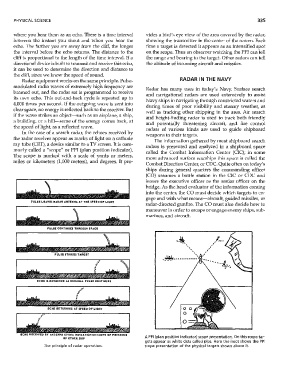
       where you hear them as an echo. There is a time interval   vides a bird's eye view of the area covered by the radal~
       between the  instant you shout and when  you hear the   showing the transmitter in the center of the screen. Each
       echo.  The farther you are away from the cliff, the longer   time a target is detected it appears as an intensified spot
       the interval before  the  echo  retums. The distance to  the   on the scope. Thus an observer watching the PPI can tell
       cliff is proportional to the length of the time interval. If a   the range and bearing to the target. Other radars can tell
       dh'ectional device is built to h'ansmit and receive this echo,   the altitude of incoming aircraft and missiles.
       it can be used to determine the direction and distance to
       the cliff, since we know the speed of sotmd.
           Radar equipment works on the same principle. Pulse-              RADAR IN THE NAVY
       modulated radio waves of extremely high frequency are
                                                              Radar has  many uses  in  today's  Navy.  Smface  search
       beamed out, and the radar set is programmed to receive
                                                              and navigational  radars  are  used  extensively  to  assist
       its own echo.  This out-and-back cycle  is  repeated up to
                                                              Navy ships in navigating through constricted waters and
       4,000 times per second. If the outgoing wave is sent into
                                                              dming times of poor visibility and stormy weather,  as
       clear space, no energy is reflected back to the receiver. But
                                                              well as  tracking other shipping in  the  area. Air search
       if the wave strikes an object-such as an airplane, a ship,
                                                              and height-finding radar is  used  to track both friendly
       a bullding, or a hill-some of the energy comes back, at
                                                              and  potentially  threatening  aircraft,  and  fire  control
       the speed of light, as a reflected wave.
                                                              radars  of  various  kinds  are  used  to  guide  shipboard
           In the case of a search radar, the echoes received by
                                                              weapons to their targets.
       the radar receiver appear as marks of light on a cathode
                                                                  The information gathered by most shipboard search
       ray tube (CRT), a device similar to a TV screen. It is com-
                                                              radars is  presented  and analyzed  in a  shipboard space
       monly called a "scope" or PPI (plan position indicator).
                                                              called  the  Combat Information Center  (CIe);  in some
       The  scope  is marked  with a  scale  of yards  or meters,
                                                              more advanced surface warships this space is called the
       miles or kilometers (1,000 meters), and degrees.  It pro-
                                                              Combat Direction Center, 01' CDC. Quite often on today's
                                                              ships  dming general quarters  the  commanding officer
                                                              (CO)  assumes a  battle  station in the  CIC  01'  CDC and
                                                              leaves  the executive  officer  as the senior officer on the
                                                              bridge. As the head evaluator of the information coming
                                                              into the center, the CO must decide which targets to en-
                                                              gage and with what means-aircraft, guided missiles, or
                                                              radar-directed gunfire. The CO must also decide how to
                                                              maneuver in order to escape or engage enemy ships, sub-
                                                              marines, and aircraft.


                        PULSE  STRIKES TARGET
                                                                     .Lt1-·H HH


                 ECHO  IS  RETURNED  AS  ORIGINAL  PULSE  CONTINUES


                     ECHO  RETURNING  A.T  SPEED OF LIGHT


                                 !~!~O~H~S~CO~P~E OF  PRESENCE
                            OF OTHER SHIP                     A PPI (plan position indicator) scope presentation. On this scope tar-
                                                              gets appear as white dots called  pips.  Here the inset shows the PPI
                    The principle of radar operation.         scope presentation of the physical targets shown above it.

