


Page 338 - NS-2 Textbook
P. 338
PHYSICAL SCIENCE                                                                                      333


           •  The frequency,  abbreviated  as  f,  is  the 11lUllber  of   the German pioneer in electromagnetic radiation, Hein-
             cycles repeated dming 1 second of tinle. If the time   rich Hertz (1857-1894). One hertz is defined as one cycle
             frame shown in the figure were 1 second long, for   per second. Frequency is expressed in terms of numbers
             example, it could be said that the frequency of the   of thousands (kilo), millions (mega), or billions (giga) of
             V\Tave shown is 3 cycles per second.             hertz. For example, 10,000 cycles per second is expressed
           •  The period, abbreviated by the Greek letter 1:  (tau)   as 10 kilohertz, abbreviated 10 kHz; 2.5 million cycles per
             is the tinle required  to complete one cycle of the   second would be 2.5 megahertz, or 2.5 MHz.
             wave. In the example above, the period would be      The behavior of an electromagnetic 'wave is depen-
             'h second. Period and frequency are l-elated by the   dent upon its frequency and corresponding wavelength.
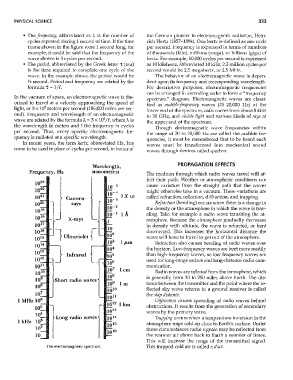
             formula 1: =  l/f.                               For  descriptive  purposes,  electromagnetic  frequencies
                                                               can be arranged in ascending order to form a Ufrequency
       In the vacuum of space, an electronlagnetic ",vave is the-      U
                                                               spectrum diagram.  Electronlagnetic  waves  are  classi-
       orized to travel at a velocity appl"oachlng  the  speed of   fied  as  audible-frequency  waves  (20-20,000  Hz)  at  the
                    8
       light, or 3 X 10 meters pel" second (186,000 miles per sec-
                                                              Imver end of the SreCh'lun, radio 'waves from about 5 kHz
       ond). Frequency and wavelength of an electromagnetic    to 30 GHz, and visible light  and various kinds of rays  at
                                            8
       wave are related by the formula A = 3 X 10 /  f, where A is
                                                              the upper end of the spectrum.
       the wavelength in meters and f the frequency in cycles
                                                                  TIlough  electromagnetic  wave  h·equencies  withln
       per  second.  Thus,  evelY  specific  electromagnetic  fre-
                                                               the range of 20  to 20,000 Hz are called  the audible fre-
       quency is radiated at a specific wavelength.
                                                               quencies, it must be remembered  that to be heard such
           In recent years, the term hertz,  abbreviated Hz, has
                                                              ,vaves  must  be  transformed  into  mechanical  SOlllld
       corne to be used in place of cycles per second, in honor of
                                                              'waves tlu'ough devices called speakers.
                                                                            PROPAGATION  EFFECTS
                                        Wavelength,
              Frequency,  Hz            nanoDlelers
                                                              The meditllll through 'which radio 'waves  travel vvill  af-
                                                              fect  their path.  Weather or atmospheric conditions can
                10 23
                                              10· 5           cause  variation  from  the  straight  path  that  the  'waves
                10 22                                         might otherwise take in a vacuum. TIl€Se variations are
                                              10- 4
                IO~I                                I X  ul   called refraction, reflection, diffraction, and trapping.
                             Gamnla-
                10 20          rays           10- •               Refractio11 (bending) occms when there is a change in
                                              10- 2           the density or the atnlosphere in 'which the wave is trav-
                10 19
                                              10- 1   I A     eling.  Take  for example a  radio wave transiting the  at-
                lOlA
                              X-rays          I               mosphere.  Because the atmosphere gradually decreases
                10 17                         10              in density  with altitude,  the  wave is refracted, or bent
                  16
                10 15  1 Ulu-d. violet r      10 2            downward.  This  increases  the  horizontal  distance  the
                10                              3             \vave vdll have to travel to get out of the atmosphere.
                  H                           10    lJLIn         Refraction also causes bending of radio waves over
                IO                              4
                                              10              the horizon. Lo\v-frequency waves are bent more readily
                  13
                10
                        J Infrared            10 5            than high-frequency 'waves, so low frequency,vaves are
                10 12                                         used for long-range radars and long-distance radio com-
                                              10 6
                10"                             7             munication.
                1010                          10   lcm            Radio 'waves are reflected frOln the ionosphere, ,vhich
                                              10 8            is generally from 30 to  250  miles above Earth. The dis-
                  9
                10      Short radio waves       9
                lOB                           10   1m         tance between the transmitter and the point where the re-
                                              1010            flected  sky V\rave  returns to a  ground receiver is called
                10 7                                          the skip distallce.
         I MHz 10 6                           10"                 Diffractioll  causes  spreading of radio waves behlnd
                                              10 12   I km    obstructions. It results from the generation of secondary
                  5
                10                            10"
                10 4                                          ,"vaves by the prin1ary lvave.
                         Long rd.dio waves    10 14               Trappi11g occurs 'when a telnperature inversion in the
         1 kHz  10'                             15            atmosphere traps cold air close to Earth's smface. Under
                                              10
                  2
                10                                            those circumstances radio signals may be reflected from
                                              10  16
                10                                            the warmer air above back to Earth a number of times.
                                                              This  will  increase  the  range  of  the  transmitted  signal.
                     The electromagnetic spectrum.            TIlis trapped cold air is called a dllct.

