


Page 49 - NS-2 Textbook
P. 49
42                                                                                      MARITIME  HISTORY

           for  a  victory.  In the first  place, neither side expected a   Lincoln's inunediate response ,vas to  begin a naval
           prolonged  war.  The  South  thought  the  North  would   blockade of all Southern ports from the Virginia Capes to
           quickly  tire  of casualties  and war expenses. It also  be-  Texas. Davis figured that Lincoln's action would so anger
           lieved Northern politics to be so unstable that the Union   the British and French merchants and textile businesses
           would never be  able  to  fight  as  one  unit.  The  border   that foreign privateers would be attracted to the South-
           states-Maryland, Delaware, Kentucky, and Missouri-     ern  cause,  tempted  by  the  great  profits  that  could  be
           while  remaining  in  the  Union,  were  at  least  partially   made.  Second,  he believed  that  this  would  eventually
           sympathetic to the Confederate cause. For example, they   force the British and French to at least recognize and as-
           supported both sides with troops.                      sist the South, if not openly join it as allies.
              TI,e Southern leadership had no idea of the economic   Davis was  wrong on both scores.  Both  British  and
           demands of modern "war~ so it \vas not able to foresee its   French shipyards built fast schooners and cruisers for the
           battlefield needs. One very important belief in the South   South to use as blockade numers, but they observed the
           was that the Northern blockade would cut off "King Cot-  Union blockade themselves.  Trade with the North was
           ton"  from  British  and  French  markets,  forcing  those   far more important to  them than trade with the South.
           cDlmtries  to help  the Southern  cause for  econon1ic  rea-  Furthermore,  in  addition  to  ne\v  sources  of  cotton  in
           sons.  This proved  to  be a vain hope, though there  was   Egypt and India, the Europeans already had huge inven-
           much sympathy for the South in Europe. When exports    tories of raw cotton from  the 1860 crop. Davis undoubt-
           of cotton from the South dwindled, Europeans turned to   edly  would have  helped  the  Confederate  cause  much
           alternative sources of supply in Egypt and india.      more if he had tried to ship out all the cotton he could be-
              In spite of these handicaps, howevel; the South had   fore  the  Union  blockade  could  become  effective.  This
           some  undeniable  strengths.  Key  among these  was  the   might have built up some cash reserves for purchasing
           high  quality  of its  officer  corps,  most of the  finest  of   war  materials  that  could  have  been  smuggled  in  by
           whom had  recently  worn  the  blue  Imiform.  Also,  the   blockade flumers.
           South was a vast territmy, not easily invaded or held by   Proclaiming a blockade and making one effective are
           anything other than a large and expensive army. Finally,   two  different  things, however.  When Lincoln  gave his
           the majority of Southerners were very loyal to the Con-  Navy the task, he had three ships in commission in home
           federate  cause,  a  fact  that  gave  the  Southern  leaders   waters to blockade and patrol 3,550 nllies of Confederate
           much comfort and enabled them to fight on against great   coast  ·with  189  harbors  and  navigable  river  mouths.
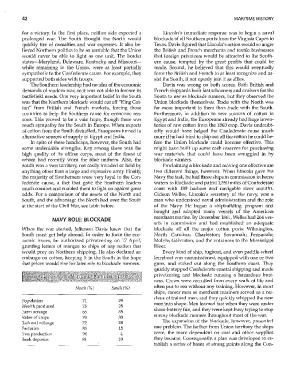
           odds.  For a comparison of the assets  of the North and   Gideon  Welles,  Lincoln's  secretary  of  the  navy,  was  a
           South, and the advantage the North had over the South   man ·who tmderstood naval administration and the role
           at the start of the Civil War, see table below.        of  the  Navy.  He  began  a  shipbuilding  program  and
                                                                  bought  and  adapted  many  vessels  of  the  American
                                                                  merchant marine. By December 1861, Welles had 264 ves-
                       NAVY ROLE:  BLOCKADE
                                                                  sels  in  conunission  and  had  established  an  adequate
           When  the  war  started,  Jefferson  Davis  knew  that  the   blockade  off  all  the  major  cotton  ports:  Wilmington,
           South must get help abroad.  In  order to  force  the eco-  North  Carolina;  Charleston;  Savarmah;  Pensacola;
           nomic  issues,  he  authorized  privateering  on  17  April,   Mobile; Galveston; and the entrances to the Mississippi
           granting letters  of marque  to  ships  of  any nation  that   River.
           would prey on Northern shipping. He also declared an      Every kind of ship, tugboat, and even paddle-wheel
           embargo on cotton, keeping it in the South in the hope   ferryboat ·was cormnissioned, equipped with one or hvo
           that prices would rise for later sale to blockade rwmers.   guns,  and  staked  out  along  the  Southern  coast.  They
                                                                  quickly stopped Confederate coastal shipping and made
                                                                  privateering  and  blockade  running  a  hazardous  busi-
                                                                  ness.  Crews ·were  recruited from  every walk of life and
                                                                  often put to sea without any h·aining. However, in most
                                 North (%)      sOllth (%)
                                                                  ships, career men or nlerchant mariners served as a nu-
                                                                  cleus of trained men, and they quickly whipped the new
           Population               71             29
                                                                  111en into shape. Men learned fast ,vhen they \vere under
           Wealth produced          75             25
          Farm acreage              65             35             shore-battery fire, and they were kept busy trying to stop
                                                                  enemy blockade rulmers tlu'oughout most of the war.
           Value of crops           70             30
          Railroad mileage          72             28                TI,e  expansion of the blockade, however, presented
                                                                  one problem. The farther from Union territory the ships
           Factories                85             15
                                                                  lvere,  the  11lore  dependent  on coal  and  other  supplies
          Iron production           96              4
          Bank deposits             81             19             they became. Consequently, a plan was developed to es-
                                                                  tablish a series of bases at sh'ong points along the Con-

