


Page 54 - NS-2 Textbook
P. 54
THE  CIVIL WAR                                                                                         47


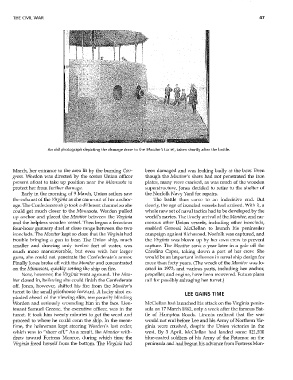
                     An  old  photograph depicting the damage done to the Monitor's turret, taken shortly after the battle.


      March, her entrance to  the area lit by the burrung COIl-  been damaged and was leaking badly at the bow. Even
      gl~ss. Worden was directed by the senior Union officer   though the MOllilor's  shots had not penetrated the iron
      present afloat to  take up position near the MilJ/lesola  to   plates, 1nan), ·were cracked, as ,vas much of the 'wooden
      protect her from further damage.                        superstruchlre. Jones  decided to  retire  to  the  shelter of
          Early in the morning of 9 March, Union sailors sa''''   the Norfolk Navy Yard for repairs.
       the exhaust of the Virgillia as she came out of her anchor-  The  battle  thus  came  to  an  indecisive  end.  But
       age. The Confederate ship took a different charmel so she   clearly, the age of ironclad vessels had arrived. With it, a
      could get much closer to the Mill/lesola.  Worden pulled   whole new set of naval tactics had to be developed by the
      up anchor and placed the MOllilor  between the Virgillia   \vorld's navies. The timely arrival of the Monitor, and nu-
       and the helpless wooden vessel. Then began a ferocious   rnerous  other  Union vessels, including  other  ironclads,
      four-hour gunneq duel at close range between the two    enabled  General  McClellan  to  launch  his  peninsular
      ironclads. The MOllitor kept so close that the Virgillia had   campaign against Richmond. Norfolk was captnred, and
       trouble  bringing a  gun to bear.  The Union ship, much   the  Virginia  was blmvn up by her own crew to  prevent
       smaller  and  drawing  only  twelve  feet  of  watel~ was   caphrre. The MOllilor  sank a year later in a  gale off the
      much  more  maneuverable,  but  even  ·with  her  larger   Carolina  Capes,  taking  down  a  part  of  her  crew.  She
       guns, she could not penetrate the Confederate's armor.   would be an important influence in naval ship design for
      Finally Jones broke off with the MOllilor and concentrated   more than forty years. (The wreck of the MOllitor was lo-
      on the Mimleso!a, quickly setting the ship on fire.     cated in 1973,  and various parts,  including her anchor,
          Nov"} hmvevel~ the Virginia went aground. The M011-  propener, and engine, have been recovered. Future plans
       itor closed in, believing she could finish the Confederate   call for possibly salvaging her hmet.)
      off.  Jones,  however, shifted his  fire  from  the MOllilor's
      hUTet  to the small pilothouse forward. A lucky shot ex-                LEE  GAINS TIME
      ploded ahead of the viewing slits, temporarily blinding
      Worden and seriously wOtmding him in the face.  Lieu-   McClellan had launched his attack on the Virginia penin-
      tenant Sanulel Greene,  the executive officer, ,vas in the   sula on 17 March 1862, only a week after the famous Bat-
       turret. It took him twenty minutes to get the word and   tle  of  Hampton  Roads.  Lincohl  realized  that  the  war
      proceed to where he could coml the ship. In the mean-   would not end before Lee and his Army of Northern Vir-
       tin1e,  the helmsman kept steering Worden's  last  order,   ginia  were  crushed,  despite  the  Union  victories  in  the
      which was to "sheer off." As a result, the MOllitor with-  west.  By 5  April,  McClellan had landed  some  121,500
       drew  to-ward  Fortress  MOlU'oe,  during  \vhich  time  the   blue-coated soldiers of his Army of the Potomac on the
       Virgillia  freed herself from the bottom. The Vilgillia  had   peninsula and had beglm his advance from Fortress Mon-

