


Page 52 - NS-2 Textbook
P. 52
THE  CIVIL WAR                                                                                         45

                                                              port could  not be held, there did not seem to be much
                                                              chance  that the Confederacy could survive.  Thereafter,
                                                              they  no  longer  seriously  considered  recognizing  the
                                                              South,  though shipyards in both nations  continued  to
                                                              build blockade runners and cruisers for the Confederacy.
                                                                  Union naval forces and supporting armies nmv con-
                                                              verged  from  both  the  north  and  south  on  Vicksburg,
                                                              Mississippi, the major remaining Confederate fortress on
                                                              the river. A major naval battle-the only real fleet action
                                                              of the war-was fought in the Mississippi at Memphis,
                                                              Tennessee.  The  entire  Confederate  river  navy  was  de-
                                                              stroyed, except for the unfinished ironclad ram Arkal1sas,
                                                              which had been towed south into  the Yazoo River.  By
                                                              late 1862 Grant had arrived to surrOlmd Vicksburg, and
                                                              Farragut had brought his  blue-ocean fleet  past Vicks-
                                                              burg. The high bluffs prevented serious naval bombard-
                                                              ment  of  the  city,  so  the  Navy  patrolled,  transported
                                                              Union  troops,  protected  the  Army's  flanks,  and  pre-
                                                              vented Confederate relief of the city. The city's defenses
       Admiral  David  Farragut  would  emerge  from  the  Civil  War at  age
       sixty as the Union's most famous naval  hero.          ·were strong, hmvever, and Vicksburg did not surrender
                                                              tmtil1863.

       rier, the superior Union fleet blasted the defenders out of
                                                                    THE  MONITOR AND THE  MERRIMACK
       the water, sinking a dozen vessels.  Farragut proceeded
       up the river to New Orleans and anchored his fleet off   As the Union was sealing off the Confederacy with the
       the quays of the port. The next day, the city surrendered,   blockade,  the  Confederates  made  plans  to  break  out.
       and the bypassed forts quickly gave up.                They  had  captured  the  USS  Merrimack,  a  new  steam
          The South's leading port was now in the hands of the   frigate burned and scuttled by Union forces  when they
       Union. It was a disaster for the Confederacy. The British   withdrew from  the Norfolk Navy Yard.  The Confeder-
       and French, who had been thinking about recognizing    ates  raised  the  vessel,  placed  her  in  drydock,  and set
       the South, now thought differently. After all,  if a  major   about converting her into the first Confederate ironclad.


                              III  II     III  III  III  II   fftn-mlThnrmfnrtrlml 'TTmrrmrrmmll =c==c-

                                                      172 feet overall
                                                      USSMonitor


                                                      263 feet overall
                                                      ess Virginia


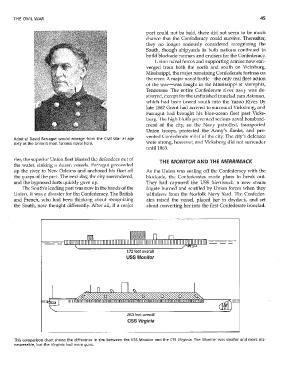
       This  comparison  chart shows  the difference  in  size  between the  USS  Monitor and the (55 Virginia.  The Monitor was  smaller and  more ma-
       neuverable, but the Virginia  had  more guns.

