


Page 59 - NS-2 Textbook
P. 59
52                                                                                      MARITIME  HISTORY


          half a  mile  apart seeking  to  rake  each other.  Soon  the     THE  BATILE  OF  MOBILE  BAY
          Kearsarge  took control of the situation. The Alabama  did
          not have the speed, and much of her ammunition ,vas in-  Following  their  victories  at Vicksburg  and  Gettysburg,
          effective. After an hour of battle, the Alabama was sink-  the Union armies shifted  their attention to  central Ten-
          ing, while the Kearsarge was only slightly damaged.     nessee.  ill  several  fierce  battles  around  Chattanooga,
              Semmes tried to beach his ship, but Winslow cut in   Grant opened  the  northwestern  door  to  Georgia.  Pro-
          front and raked the Alabama again. Water rushing into the   moted by Lincoln to become supreme commander of all
          Confederate ship extinguished her boilers, and Semmes   Union forces,  Grant now ,vent to  Vil'ginia  to  cOlnmand
          struck his colors. As the Alabama began to sink, the Deer-  the Army of the Potomac.  He left General  Sherman in
          hOllnd came in to pick up survivors. Semmes and forty of   command of the ·western arnlY,  with orders to march on
          his crew were taken to England, escaping capture.       Atlanta, Georgia.
              TI,e  Alabama  had  caphtred  more  than  sixty  Union   The impending Atlanta campaign pushed ahead Ad-
          ships  during her commerce  raiding,  destroying most at   miral Farragut's plans to close off the last of the Confed-
          sea. The Northern steamship lines suffered huge losses. Be-  eracy's  Gulf ports, Mobile,  Alabama.  Sherman  figured
          cause  the  raider  was built in Britain,  the  British  govern-  that a naval assault on Mobile would cause the Confed-
          ment later had to pay $15.5 million in claims as the result   erates  to  move muts defending Atlanta to  the Gulf.  ill
          of an international court ruling in Geneva} Switzerland.   July 1864, therefore, Farragut was given additional mon-
              Other Confederate raiders also enjoyed much success   itors and an amphibious troop contingent to besiege and
          against  Northern  shipping.  One,  the  CSS  Shel1al1doah,   capture the forts guarding the entrance to Mobile Bay.
          commanded by Captain James  Waddell,  wreaked  such        Mobile was a strategic port for the South. It had been
          havoc among Union whaling ships in the Aleutian Islands   the leading cotton-shipping port of the Uluted States be-
          near Alaska that she all but destroyed the American whal-  fore the Wat, Accordingly, the Confederates had prepared
          ing industry. Altogether the raiders sank about 5 percent   defenses for the harbor stronger thatl any other on their
          of all Union merchant ships that sailed  during the war.   coast.  Three strong forts  guarded the outer entrallce  to
          Costly as this was, these losses did not have much effect   the bay.  Fort Gaines on Dauphine Island and Fort Mor-
          on the  outcome  of  the  war,  mainly because  more  and   gan protected  the main entrance. Slups had  to pass di-
          lnore cargo ,vas carried by neutral ships safe fronl Con-  rectly  under  the  glms  of Fort Morgan  to  enter Mobile
          federate  attack.  However, American merchant shipping   Bay.  Pilings  formed  a  submerged  obsh·uction  2  miles
          was dealt a blow from which it never recovered.        long from Fort Gaines toward the main channel. A triple


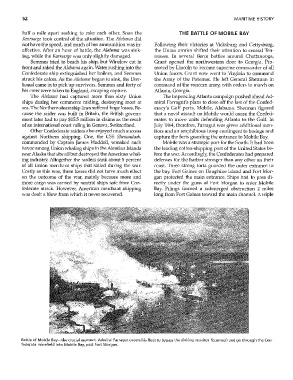
          Battle of Mobile Bay-the crucial moment. Admiral Farragut orders his fleet to bypass the sinking monitor Tecumseh and go through the Con-
          federate minefield into Mobile Bay,  past Fort Morgan.

