


Page 61 - NS-2 Textbook
P. 61
54                                                                                      MARITIME HISTORY


                                                                  for  fleet  support,  Terry's  forces  moved  forward  with
                                                                  naval bombardment just ahead. Caught behveen Terry's
                                                                  forces and the naval landing force, the 1,800 Confederate
                                                                  slu"vivors surrendered.
                                                                      When Navy secretary Welles informed Lincoln of the
                                                                  victory  at Fort Fisher,  the  president suddenly realized,
                                                                  "Why,  there is notlllilg left for  your ships to do!" And
                                                                  that was true.
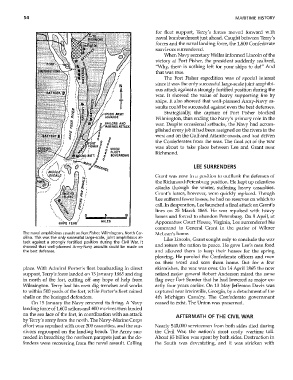
                                                                      The  Fort  Fisher  expedition  was  of  special  interest
                                                                  since it was the only successful large-scale joint amphibi-
                                                                  ous attack against a strongly fortified position during the
                                                                  war.  It showed  the  value  of heavy  supporting  fire  by
                                                                  ships. It also showed that well-plaImed Army-Navy as-
                                                                  saults could be successful against even the best defenses.
                                                                      Strategically,  the  caphue  of  Fort  Fisher  blocked
                                                                  Wihnington, thus ending the Navy's primaq role in the
                                                                  war. Despite occasional setbacks, the Navy had accom-
                                                                  plished every job it had been assigned on the rivers in the
                                                                  west and on the Gulf and Atlantic coasts, and had driven
                                                                  the Confederates from the seas. The final act of the war
                                                                  was  about  to  take  place  behveen Lee  and  Grant near
                                                                  Riclunond.


                                                                                  LEE  SURRENDERS
                                                                  Grant was now in a  position to outflaI1k the defenses of
                                                                  the Richmond-Petersburg position. He kept up relentless
                                                                  attacks  through  the  winter,  suffering  heavy  casualties.
                        , ...... :-~J~:i-Ht§:~~:
                       .'  _;:_q5L~NO-~,                          Grant's losses, however, ""vere  quickly replaced.  TIl0ugh
                                                                  Lee suffered fe,\ver losses, he had no reserves on \vhich to
                      :' .~:'~4~J                                 call. In desperation, Lee launched a final attack on GraIl!' s
                                                                  lines  on  25  March  1865.  He  was  repulsed  with heavy
                         '.   "c~'~,-_   Q           tp           losses and forced to abaIldon Petersburg. On 9 April, at
                                           MILES
                          ~A'PE FEAR'"                            Appomattox Court House, Virginia, Lee smrendered his
                                                                  conunand  to  General  Grant  in  the  parlor  of  Wilmer
           The naval amphibious assault on Fort Fisher, Wilmington, North Car-  McLean's home.
           olina.  This was the only successful  large-scale, joint amphibious at-  Like Lincoln, Grant sought only to conclude the war
           tack  against  a  strongly  fortified  position  during  the  Civil  War.  It
           showed  that  well-planned  Army-Navy  assaults  (ould  be  made  on   aIld rehlr11 the nation to peace. He gave Lee's men food
           the best defenses.                                     and  allowed  them to  keep  their horses for  the  spring
                                                                  plowing. He paroled the Confederate officers and men
                                                                  on  their  word  and  sent  them  home.  But  for  a  few
           place. With Admiral Porter's fleet bombarding in direct   skirmishes, the war was over. On 14 April 1865 the now
           support, Teny's force landed on 13 January 1865 and dug   retired major general Robert Anderson raised the srune
           in north of the fort,  cutting off any hope of help from   flag over Fort Sumter that he had lowered as major ex-
           Wihnington. Terry had his men dig trenches and works   actly four years earlier. On 10 May Jefferson Davis was
           to within 500 yards of the fort, while Porter's fleet rained   captmed near rn"inville, Georgia, by a detachment of the
           shells on the besieged defenders.                      4th  Michigan  Cavalry.  TIle  Confederate  government
              On 15 January the Navy renewed its firing. A Navy   ceased to exist. The Union 'vas preserved.
           landing force of 1,600 sailors and 400 marines then landed
           on the sea face of the fort, in coordination with an attack     AFTERMATH  OF THE  CIVIL WAR
           by Terry's army from the north. The Navy-Marine Corps
           effort was repulsed with over 300 casualties, and the sur-  Nearly 540,000 servicemen from both sides died during
           vivors regrouped on the landing beach. The Army suc-   the  Civil  War,  the  nation's  most  costly  wartime  toll.
           ceeded in breaching the northern parapets just as the de-  About $5 billion was spent by both sides. Destruction in
           fenders were recovering from the naval assault. Calling   the  South  was  devastating,  and  it  was  stricken  with

