


Page 65 - NS-2 Textbook
P. 65
58                                                                                       MARITIME HISTORY


          healthy social activities. By 1869 the academy's engineer-  men  on  station  ships  before  they  were  transferred  to
          ing curriculum and physics department had achieved a    training vessels to be taught gtmnery and seamanship.
          high academic reputation, which continues to this day. In   This ,vas the forenuuler of the Navy's lllodern training
          the  early  1870s  the  department  attracted  a  brilliant   systelll for enlisted nlen.
          young immigrant from Germany named Albert Michel-          In 1884 after a brilliant career in sea billets  (job  as-
          son} tvho, after graduating and serving as an instructor at   signments aboard ships), including the Naval Academy
          the academy, went on to head the department of physics   training  squadron,  Luce  convinced the  secretary  of the
          at the University of Chicago. He became the first Atnel'i-  navy  to  establish  the  Naval  War  College  in  Newport,
          can recipient of the Nobel Prize for  Physics in 1907 for   Rhode Island. Luce had argued that naval warfare of the
          discovering the speed of light.                        fuhue would require senior officers well schooled in the
              In 1873  the U.s.  Naval Instihlte was established on   broad principles of grand strategy, modern fleet  tactics,
          the grounds of the Naval Academy. Composed of officers   naval history and policy, and internationallmv. The col-
          and civilian instructors at  the academy interested  in  re-  lege  was  the  first  institution of its kind in  the  world.
          fornl, the instihlte/s purpose was to advance professional   Among the excellent officers selected by Luce for the first
          and  scientific  knowledge  about  the  U.s.  Navy,  other   Naval  War  College  staff  was  Captain  Alfred  Thayer
          world navies, and the Inaritime industry. It soon became   Mahan,  professor  of  naval  history,  who  would  soon
          a major forum for ideas to improve the fleet.  In 1875 it   l1lake history hunself.
          began publishing a journal called the U.s. Naval Institute   Today's  naval  training  programs  for  both  officers
          Proceedings. The Proceedings was a leader in criticizing the   and enlisted personnel stem directly from Commodore
          condition of the fleet, pointing out both the commercial   Luce's efforts. He also started fleet exercises as a means
          benefits  and naval  requirements  of a  sh'ong American   of battle practice, and until his death in 1917 at the age of
          maritime force. This professional journal is still the fore-  ninety,  he  fought  tirelessly for  improvements  in  ships
          most naval and maritime publication of its  type in the   and glm design. His work contributed immensely to im-
          world. Evenhtally the Naval Institute also became an im-  proving the morale of the service following its post-Civil
          portant publisher of books on naval matters.           War decline.
              Also in 1875, Luce"  now a conunodore/ was instru-
          mental in  starting  a  system  of  training naval  enlisted
                                                                             MAHAN AND SEA  POWER
                                                                 In 1886 Commodore Luce was ordered to sea duty again,
                                                                 and Captain Alfred 111ayer Mahan was appointed to re-
                                                                 lieve  him  as  president  of  the  Naval  War  College.  As
                                                                 Mahan shldied naval history in preparation for assum-
                                                                 ing his duties, he became convinced that the importance
                                                                 of sea control in human history had never been fully ap-
                                                                 preciated 01' properly communicated. From this time on
                                                                 he became one of the foremost proponents of sea power
                                                                 as  a  means  to  achieve  ,,,,arId  power status.  In  1890  he
                                                                 published his findings in The Il1flllellce of Sea Power lIpOI1
                                                                 History,  1660-1783,  which became world famous  as the
                                                                 foremost text on sea power and naval strategy. He pub-
                                                                 lished two more studies in 1892 and 1897.
                                                                     Mahan argued that it was command of the sea that
                                                                 had enabled Britain to create its empire, reap the profits
                                                                 of maritime commerce, and defeat the land powers that
                                                                 tried to challenge it on the trade routes of the world. He
                                                                 believed  that a seafaring nation could, if led by an en-
                                                                 lightened and dynamic  govermnent,  use the sea  to be-
                                                                 come a world power. For the United States, or any other
                                                                 nation desiring to become a ·world power, the lesson ,vas
                                                                 clear:  national stu'vival  depended on control of the sea.
                                                                 The cOlmtry needed to build a fleet of ships that could
                                                                 defeat any enemy fleet at sea and break up any blockade
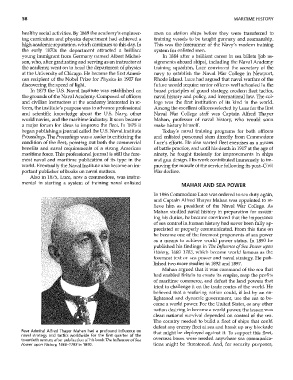
          Rear  Admiral  Alfred  Thayer  Mahan  had  a  profound  influence  on
          naval  strategy  and  tactics  worldwide  for  the  first  quarter  of  the   that might be deployed against it.  To  support this fleet,
                                                                 overseas bases were needed an)"vhere sea comnllmica-
          twentieth century after publication of his book The Influence of Sea
          Power upon History,  1660-1783 in  1890.               tions  might be threatened.  Atld, for  security  purposes,

