


Page 147 - Jurnal Kurikulum BPK 2020
P. 147
for school governance, school infrastructure, teachers and learning. Standards can be used to
track progress towards achieving the broad strategic goals set by the authority such as Ministry
of Education. At the same time, standards provide the criteria for people at the local, state and
national levels to judge if the learning have achieved what it sets out to so that collectively it
will bring coherence towards the improvement of education system. In Malaysia, the National
Standard of School Education (Standard Kebangsaan Pendidikan Malaysia, 2012) and National
Teaching Standard (Standard Perguruan Malaysia, 2013) were developed to improve the
quality of the education system. In 2010 a decision was made by the Curriculum Development
Division to complement these standards with curriculum standards, giving rise to KSSR and
KSSM. The curriculum standards is envisaged to ensure equity of education and at the same
time embody excellence as aspired in the Malaysia Education Blueprint 2013-2025. In KSSR
and KSSM, Curriculum Standard consists of Content Standard, Learning Standard and
Performance Standard. Content Standards are specific statements about what students should
know and can do during the schooling period encompassing knowledge, skills and values.
Learning Standards are predetermined criteria or indicator of the quality in learning and can be
measured for each content standard. Performance Standard is a set of general to specific criteria
which reflects the levels of students’ achievement that they should display as a sign of learning
have been acquired, it is the indicator of success (BPK, 2016 a,b; 2018 a,b). With the inclusion
of performance standards for each content standard, this is also the first time in the history of
curriculum development in Malaysia where assessment specifically classroom based
assessment is incorporated into the formal curriculum document.
Microscopic Curriculum Design in the National Curriculum
Microscopic curriculum design is concerned with how the four components of
curriculum (learning objectives, learning experiences, subject matter, and evaluation) are
organised (Klein, 1991). From KBSR/KBSM to Revised KBSR/KBSM to KSSR/KSSM,
content of the subjects are arranged under either topics, learning areas or themes depending on
the needs of each individual subject (1992 a, b, c, d). Themes provide the story line of the whole
curriculum indicative of the structure and organising principles chosen for the particular
subject. Each theme could in turn comprises several learning areas, providing the content of the
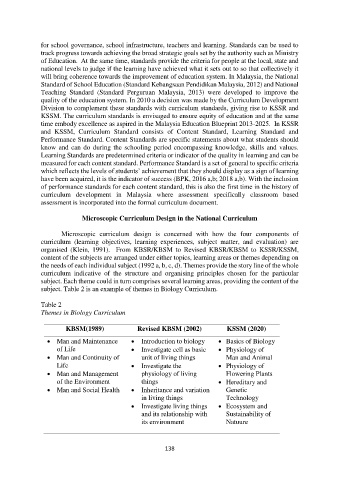
subject. Table 2 is an example of themes in Biology Curriculum.
Table 2
Themes in Biology Curriculum
KBSM(1989) Revised KBSM (2002) KSSM (2020)
Man and Maintenance Introduction to biology Basics of Biology
of Life Investigate cell as basic Physiology of
Man and Continuity of unit of living things Man and Animal
Life Investigate the Physiology of
Man and Management physiology of living Flowering Plants
of the Environment things Hereditary and
Man and Social Health Inheritance and variation Genetic
in living things Technology
Investigate living things Ecosystem and
and its relationship with Sustainability of
its environment Natuure
138

