


Page 146 - Jurnal Kurikulum BPK 2020
P. 146
classroom teachings, students were seen to be learning passively in the classroom (Ng, 2004,
               2010).  The  Smart  School  Science  and  Mathematics  Curriculum  made  a  first  attempt  to
               incorporate thinking processes in the learning outcomes to remind the users of the need to teach
               thinking through subject matter. In another word, the outcome of the learning is not only subject
               matter but also thinking abilities. This thinking based curriculum design was further improved
               in the revised KBSR and KBSM science and mathematics curriculum, and in KSSR and KSSM
               all subjects adopted this thinking based curriculum design.  This thinking based curriculum
               design  which  is  referred  to  as  the  thoughtful  learning  curriculum  design  in  science  and
               mathematics curriculum is a fusion of discipline (D) design and cognitive processes(C) design
               (Ng, 2004). Under the framework of DC design, all intended learning outcomes, besides those
               of inculcation of attitude and moral values are a combination of acquisition of knowledge and
               mastery of cognitive skills. This is in tandem with the idea of integration of content and process
               as  the  dual  agenda  of  a  thinking  curriculum  (Resnick  &  Klopfer’s,  1989;  Fennimore  and
               Tinzman,  1990).  Through  this  thinking  curriculum,  students  are  taught  content  through
               processes  encountered  in  the  real  world,  examples  of  the  processes  are  problem  solving,
               decision  making,  evaluating  and  comparing.    These  processes  are  specific  to  different
               disciplines,  thus  in  science,  the  way  scientists  hypothesise,  testing  the  hypothesis,  making
               inferences, analyse, synthesise are the processes or crafts that students should learn and practise
               in science lessons. Perkins (1992) supported this idea of integrating content and process, to
               him, acquisition of content knowledge should be brought about by “learning experiences in
               which learners think about and think with what they are learning” (p. 8).  Such learning is
               thoughtful  learning  (Perkins,  1992).    Perkins  (1992)  expressed  his  opposition  towards  the
               conventional practice where students are first provided the knowledge, and then only they are
               given the opportunity to think with and think about the knowledge they absorbed. Perkins
               (1992) advocated that learning can only be achieved through thinking.

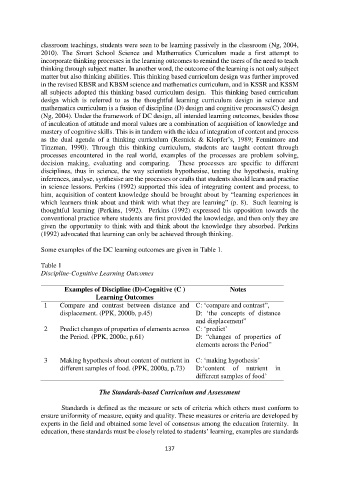
               Some examples of the DC learning outcomes are given in Table 1.

               Table 1
               Discipline-Cognitive Learning Outcomes

                        Examples of Discipline (D)-Cognitive (C )                 Notes
                                   Learning Outcomes
                1     Compare  and  contrast  between  distance  and  C: ‘compare and contrast”,
                      displacement. (PPK, 2000b, p.45)                D:  ‘the  concepts  of  distance
                                                                      and displacement”
                2     Predict changes of properties of elements across  C: ‘predict’
                      the Period. (PPK, 2000c, p.61)                  D:  “changes  of  properties  of
                                                                      elements across the Period”

                3     Making hypothesis about content of nutrient in  C: ‘making hypothesis’
                      different samples of food. (PPK, 2000a, p.73)   D:‘content  of  nutrient  in
                                                                      different samples of food’

                                    The Standards-based Curriculum and Assessment

                       Standards is defined as the measure or sets of criteria which others must conform to
               ensure uniformity of measure, equity and quality. These measures or criteria are developed by
               experts in the field and obtained some level of consensus among the education fraternity.  In
               education, these standards must be closely related to students’ learning, examples are standards


                                                           137

