


Page 25 - Jurnal Kurikulum BPK 2018
P. 25
The aims and objectives above are the building blocks of producing holistic Malaysians who will
               be able to pursue higher education or join the workforce, able to face current challenges and
                                  st
               challenges of the 21  century as well as be a global player.

                         Curriculum Framework for Kindergartens in the Republic of Singapore

                      The curriculum framework for kindergartens in Singapore as its aptly named Nurturing
               Early Learners:  A Curriculum Framework for Kindergartens in Singapore.  This curriculum has
               been  in  place  since  2013  to  assist  preschool  teachers  in  designing  and  implementing  quality
               teaching  and  learning  for  children  aged  four  to  six.  Its  common  abbreviation  is  “the  NEL
               framework which spells out six principles, encapsulated in the acronym “iTeach” as the basis for
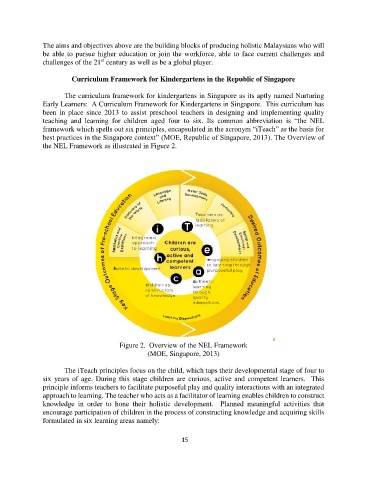
               best practices in the Singapore context” (MOE, Republic of Singapore, 2013). The Overview of
               the NEL Framework as illustrated in Figure 2.


                                         Figure 2.  Overview of the NEL Framework
                                                  (MOE, Singapore, 2013)

                      The iTeach principles focus on the child, which taps their developmental stage of four to
               six years of age. During this stage children are curious, active and competent learners.  This
               principle informs teachers to facilitate purposeful play and quality interactions with an integrated
               approach to learning. The teacher who acts as a facilitator of learning enables children to construct
               knowledge  in  order  to  hone  their  holistic  development.    Planned  meaningful  activities  that
               encourage participation of children in the process of constructing knowledge and acquiring skills
               formulated in six learning areas namely:


                                                             15

