


Page 170 - Jurnal Kurikulum BPK 2020
P. 170
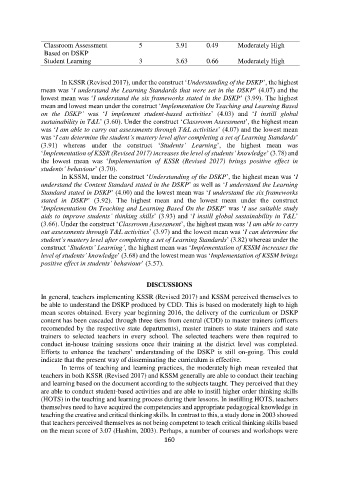
Classroom Assessment              5            3.91       0.49       Moderately High
                Based on DSKP
                Student Learning                  3            3.63       0.66       Moderately High


                       In KSSR (Revised 2017), under the construct ‘Understanding of the DSKP’, the highest
               mean was ‘I understand the Learning Standards that were set in the DSKP’ (4.07) and the
               lowest mean was ‘I understand the six frameworks stated in the DSKP’ (3.99). The highest
               mean and lowest mean under the construct ‘Implementation On Teaching and Learning Based
               on  the  DSKP’  was  ‘I  implement  student-based  activities’  (4.03)  and  ‘I  instill  global
               sustainability in T&L’ (3.60). Under the construct ‘Classroom Assessment’, the highest mean
               was ‘I am able to carry out assessments through T&L activities’ (4.07) and the lowest mean
               was ‘I can determine the student’s mastery level after completing a set of Learning Standards’
               (3.91)  whereas  under  the  construct  ‘Students’  Learning’,  the  highest  mean  was
               ‘Implementation of KSSR (Revised 2017) increases the level of students’ knowledge’ (3.78) and
               the  lowest  mean  was  ‘Implementation  of  KSSR  (Revised  2017)  brings  positive  effect  in
               students’ behaviour’ (3.70).
                       In KSSM, under the construct ‘Understanding of the DSKP’, the highest mean was ‘I
               understand the Content Standard stated in the DSKP’ as well as ‘I understand the Learning
               Standard stated in DSKP’ (4.00) and the lowest mean was ‘I understand the six frameworks
               stated  in  DSKP’  (3.92).  The  highest  mean  and  the  lowest  mean  under  the  construct
               ‘Implementation On Teaching and Learning Based On the DSKP’ was ‘I use suitable study
               aids to improve students’ thinking skills’ (3.93) and ‘I instill global sustainability in T&L’
               (3.66). Under the construct ‘Classroom Assessment’, the highest mean was ‘I am able to carry
               out assessments through T&L activities’ (3.97) and the lowest mean was ‘I can determine the
               student’s mastery level after completing a set of Learning Standards’ (3.82) whereas under the
               construct ‘Students’ Learning’, the highest mean was ‘Implementation of KSSM increases the
               level of students’ knowledge’ (3.68) and the lowest mean was ‘Implementation of KSSM brings
               positive effect in students’ behaviour’ (3.57).


                                                     DISCUSSIONS
               In general, teachers implementing KSSR (Revised 2017) and KSSM perceived themselves to
               be able to understand the DSKP produced by CDD. This is based on moderately high to high
               mean scores obtained. Every year beginning 2016, the delivery of the curriculum or DSKP
               content has been cascaded through three tiers from central (CDD) to master trainers (officers
               recomended by the respective state departments), master trainers to state trainers and state
               trainers  to  selected  teachers  in  every  school.  The  selected  teachers  were  then  required  to
               conduct  in-house  training  sessions  once  their  training  at  the  district  level  was  completed.
               Efforts  to  enhance  the  teachers’  understanding  of  the  DSKP  is  still  on-going.  This  could
               indicate that the present way of disseminating the curriculum is effective.
                       In terms of teaching and learning practices, the moderately high mean revealed that
               teachers in both KSSR (Revised 2017) and KSSM generally are able to conduct their teaching
               and learning based on the document according to the subjects taught. They perceived that they
               are able to conduct student-based activities and are able to instill higher order thinking skills
               (HOTS) in the teaching and learning process during their lessons. In instilling HOTS, teachers
               themselves need to have acquired the competencies and appropriate pedagogical knowledge in
               teaching the creative and critical thinking skills. In contrast to this, a study done in 2003 showed
               that teachers perceived themselves as not being competent to teach critical thinking skills based
               on the mean score of 3.07 (Hashim, 2003). Perhaps, a number of courses and workshops were
                                                           160

