


Page 131 - fbkCardioDiabetes_2017
P. 131
Cardio Diabetes Medicine 2017                                    107


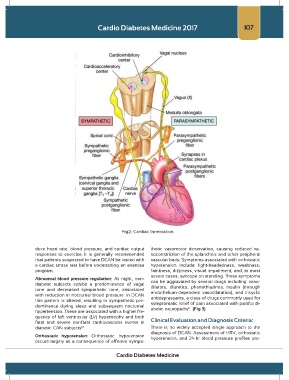
                                                       Fig2: Cardiac Innervation


                 duce heart rate,  blood  pressure,  and cardiac output   thetic  vasomotor  denervation, causing reduced  va-
                 responses  to exercise.  It is  generally  recommended   soconstriction of the splanchnic and other peripheral
                 that patients suspected to have DCAN be tested with   vascular beds. Symptoms associated with orthostatic
                 a cardiac stress test before undertaking an exercise   hypotension include:  light-headedness, weakness,
                 program.                                           faintness, dizziness, visual impairment, and, in most
                                                                    severe cases, syncope on standing. These symptoms
                 Abnormal  blood  pressure  regulation: At night, non-  can be aggravated by several drugs including: vaso-
                 diabetic subjects exhibit a predominance of vagal   dilators,  diuretics, phenothiazines,  insulin (through
                 tone and decreased  sympathetic tone, associated   endothelium-dependent vasodilatation),  and tricyclic
                 with reduction in nocturnal blood pressure. In DCAN   antidepressants, a class of drugs commonly used for
                 this pattern is altered, resulting in sympathetic  pre-  symptomatic relief of pain associated with painful di-
                 dominance  during  sleep  and subsequent nocturnal   abetic neuropathy . (Fig 3)
                                                                                    11
                 hypertension. These are associated with a higher fre-
                 quency of left ventricular (LV) hypertrophy and both
                 fatal and  severe  nonfatal  cardiovascular events  in   Clinical Evaluation and Diagnosis Criteria:
                 diabetic CAN subjects .                            There  is  no widely  accepted single  approach  to the
                                     10
                                                                    diagnosis of DCAN. Assessment of HRV, orthostatic
                 Orthostatic  hypotension:  Orthostatic  hypotension   hypotension, and 24-hr blood  pressure profiles pro-
                 occurs largely as a consequence of efferent sympa-


                                                    Cardio Diabetes Medicine

