


Page 132 - fbkCardioDiabetes_2017
P. 132
108             Diabetic Cardiovascular Autonomic Neuropathy


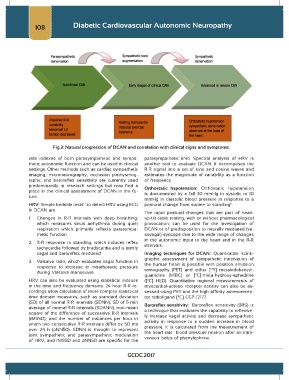
                        Fig.3: Natural progression of DCAN and correlation with clinical signs and symptoms.

              vide indexes  of both  parasympathetic  and  sympa-  parasympathetic limb. Spectral analysis  of HRV is
              thetic autonomic function and can be used in clinical   another tool  to evaluate DCAN.  It decomposes  the
              settings. Other methods such as cardiac sympathetic   R-R  signal into a set of sine and  cosine waves and
              imaging,  microneurography,  occlusion plethysmog-  estimates the  magnitude  of variability as a function
              raphy, and  baroreflex  sensitivity are currently used   of frequency.
              predominantly  in research  settings  but may find a   Orthostatic  hypotension:  Orthostatic  hypotension
              place in the clinical assessment of DCAN in the fu-  is  documented by  a  fall  30 mmHg  in systolic  or  10
              ture.
                                                                 mmHg in diastolic blood pressure  in response  to a
              HRV: Simple bedside tests  to detect HRV using ECG   postural change from supine to standing .
                                                                                                       11
                                      12
              in DCAN are:
                                                                 The  rapid  postural  changes  that  are  part  of  head-
              1.   Changes in R-R  intervals with  deep  breathing,   up-tilt-table testing, with or without pharmacological
                 which  measures  sinus arrhythmia during  quiet   provocation,  can be used for  the investigation of
                 respiration  which  primarily  reflects  parasympa-  DCAN or of predisposition to neurally mediated (va-
                 thetic function                                 sovagal) syncope due to the wide range of changes
                                                                 in  the autonomic input to the heart and in  the R-R
              2.  R-R response  to standing, which  induces reflex
                 tachycardia followed by bradycardia and is jointly   intervals.
                 vagal and baroreflex mediated                   Imaging techniques  for DCAN:  Quantitative  scinti-
                                                                 graphic  assessment of  sympathetic innervation of
              3.  Valsalva ratio, which evaluates vagal function in   the human heart is  possible  with positron  emission
                 response  to  increase in intrathoracic  pressure   tomography (PET)  and  either [ I] metaiodobenzyl-
                                                                                              123
                 during Valsalva manoeuvre
                                                                 guanidine (MIBG) or  [ C]-meta-hydroxy-ephedrine
                                                                                       11
              HRV can also be evaluated using statistical indexes   ([ C]  HED).  Quantitative  regional measurements of
                                                                  11
              in the time and frequency domains. 24 hour R-R re-  myocardial-adreno  receptor  density  can  also  be  as-
              cordings allow calculation of more complex statistical   sessed using PET and the high-affinity–adrenorecep-
              time domain measures,  such as  standard deviation   tor radioligand [ C] CGP-12177
                                                                               11
              (SD) of all normal R-R intervals (SDNN), SD of 5-min   Baroreflex sensitivity:  Baroreflex  sensitivity  (BRS) is
              average of normal R-R intervals (SDANN), root-mean   a technique that evaluates the capability to reflexive-
              square of the difference of successive R-R intervals   ly increase  vagal activity  and  decrease  sympathetic
              (rMSSD),  and  the  number  of instances  per  hour in   activity  in response  to a sudden increase  in blood
              which two consecutive R-R intervals differ by 50 ms   pressure.  It is calculated  from the  measurement  of
              over 24  h (pNN50). SDNN  is thought  to represent   the heart rate– blood pressure relation after an intra-
              joint sympathetic  and  parasympathetic modulation   venous bolus of phenylephrine.
              of HRV, and rMSSD and pNN50 are specific for the


                                                         GCDC 2017

