


Page 178 - fbkCardioDiabetes_2017
P. 178
154         Stroke in Cardiodiabetic SyndromeHow different is it?


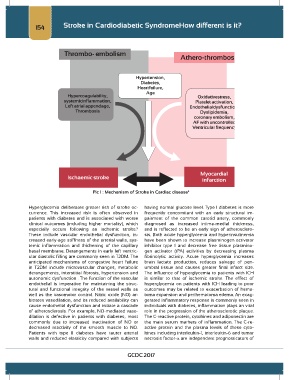
                                          Pic 1 : Mechanism of Stroke in Cardiac disease 4


              Hyperglycemia deliberates greater risk of stroke oc-  having normal glucose level. Type I diabetes is more
              currence. This increased risk is  often observed  in   frequently  concomitant  with an early  structural  im-
              patients with diabetes and is associated with worse   pairment of the  common  carotid  artery,  commonly
              clinical  outcomes  (including higher  mortality),  which   diagnosed  as increased  intima-medial thickness,
              especially  occurs  following  an ischemic stroke.    and is reflected to be an early sign of atherosclero-
                                                             5
              These  include vascular  endothelial dysfunction,  in-  sis. Both acute hyperglycemia and hyperinsulinemia
              creased early-age stiffness of the arterial walls, sys-  have been shown to increase plasminogen activator
              temic  inflammation  and  thickening  of the  capillary   inhibitor type  1  and decrease  free  tissue  plasmino-
              basal membrane. Derangements in early left ventric-  gen activator  (tPA) activities  by decreasing  plasma
              ular diastolic filling are commonly seen in T2DM. The   fibrinolytic activity.  Acute  hyperglycemia  increases
              anticipated  mechanisms  of congestive heart failure   brain lactate  production, reduces  salvage  of pen-
              in T2DM include  microvascular changes,  metabolic   umbral tissue  and causes  greater  final infarct size.
              derangements, interstitial fibrosis, hypertension and   The influence of hyperglycemia to patients with ICH
              autonomic dysfunction . The function of the vascular   is similar to that  of ischemic stroke.  The effect  of
              endothelial is imperative for maintaining  the  struc-  hyperglycemia  on patients with ICH  leading  to poor
              tural and functional  integrity  of  the vessel  walls  as   outcomes may be related to exacerbation of hema-
              well  as the vasomotor control. Nitric  oxide  (NO) ar-  toma expansion and perihematoma edema. An exag-
              bitrates vasodilation, and its reduced availability can   gerated inflammatory response is commonly seen in
              cause endothelial dysfunction and initiate a cascade   individuals with diabetes, inflammation plays an vital
              of atherosclerosis. For example, NO-mediated vaso-  role in the progression of the atherosclerotic plaque.
              dilation is  defective in patients with  diabetes, most   The C-reactive protein, cytokines and adiponectin are
              commonly due  to increased inactivation  of NO  or   the main serum markers  of inflammation.  The C-re-
              decreased  reactivity  of the smooth  muscle to NO.   active protein  and the plasma  levels  of these  cyto-
              Patients with type  II  diabetes  have tauter arterial   kines including interleukin-1, interleukin-6 and tumor
              walls and reduced elasticity compared with subjects   necrosis factor-α are independent prognosticators of


                                                         GCDC 2017

