


Page 179 - fbkCardioDiabetes_2017
P. 179
Cardio Diabetes Medicine 2017                                    155


                 cardiovascular risk. Adiponectin seems to be a mod-  References
                 ulator of lipid  metabolism and systemic inflamma-  1.  Ferro JM. Brain embolism. Answers to practical questions.  J Neurol.
                 tion. A  low  level  of  adiponectin itself  has also  been   2003;250:139–47.
                 associated with CVD. 5                             2.  Weir  NU. An update on cardioembolic  stroke.  Postgrad Med J.
                                                                      2008;84:133–42.
                                                                    3.  Di Tullio MR, Homma S. Mechanisms  of cardioembolic stroke. Curr Car-
                                                                      diol Rep. 2002;4:141–8
                                                                    4.  Haeusler KG, Laufs U, Endres M (2011) Chronic heart failure and ischemic
                                                                      stroke. Stroke 42:2977– 2982
                                                                    5.  Chen R, Ovbiagele  B, Feng W. Diabetes  and Stroke:  Epidemiology,
                                                                      Pathophysiology, Pharmaceuticals  and Outcomes.  The American  jour-
                                                                      nal of  the medical sciences.  2016;351(4):380-386.doi:10.1016/j.am-
                                                                      jms.2016.01.011.


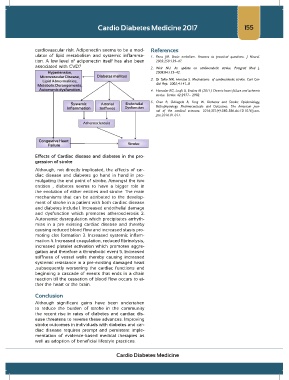
                 Effects of Cardiac  disease  and diabetes  in the pro-
                 gression of stroke
                 Although, not directly implicated, the effects of car-
                 diac disease  and diabetes  go  hand  in hand  in pro-
                 mulgating the end point of stroke. Amongst the two
                 entities , diabetes  seems  to have a bigger  role  in
                 the evolution of either entities and stroke. The main
                 mechanisms  that  can  be  attributed to the develop-
                 ment of stroke in a patient with both cardiac disease
                 and diabetes include 1. Increased endothelial damage
                 and dysfunction which  promotes  atherosclerosis  2.
                 Autonomic dysregulation which precipitates arrhyth-
                 mias  in a pre  existing  cardiac disease  and thereby
                 causing reduced blood flow and increased stasis pro-
                 moting  clot  formation  3.  Increased  systemic inflam-
                 mation 4. Increased coagulation, reduced fibrinolysis,
                 increased  platelet  activation which  promotes  aggre-
                 gation and therefore a thrombotic event 5. Increased
                 stiffness of vessel  walls thereby causing  increased
                 systemic resistance in a pre-existing damaged heart
                 ,subsequently worsening  the cardiac  functions  and
                 beginning a cascade of events that ends in a chain
                 reaction till the cessation of blood flow occurs to ei-
                 ther the heart or the brain.
                 Conclusion
                 Although significant  gains  have been undertaken
                 to  reduce the  burden of stroke  in the  community
                 the  recent  rise in rates of diabetes and  cardiac  dis-
                 ease threatens to reverse these advances. Improving
                 stroke outcomes in individuals with diabetes and car-
                 diac disease  requires  prompt  and persistent  imple-
                 mentation  of evidence-based medical therapies  as
                 well as adoption of beneficial lifestyle practices.


                                                    Cardio Diabetes Medicine

