


Page 280 - fbkCardioDiabetes_2017
P. 280
256               Cardiac Complications in Diabetic Ketoacidosis


              •  Drugs (cocaine)                                 low levels  of insulin. By  12 hours of treatment  with
                                                                 fluids and insulin , the extracellular potassium can
              •  Pregnancy
                                                                 shift intracellularly causing hypokalemia. Serial ECG’s
              DKA consists  of  the triad  of  hyperglycemia  , keto-  would be helpful in early  detection  of hypokalemia
              sis  and  acidosis. Cardiovascular complications  is   or hyperkalemia.
              increased  in  individuals  with  type  1  and type  2  DM.   Hypokalemia  is  associated with ECG abnormalities
              There has been little change in the mortality rate as-  and cardiac arrhythmias. The most common and the
              sociated with DKA despite great improvements in our   earliest ECG finding in hypokalemia is a prominent U
              understanding of its pathophysiology and treatment.    wave. ST  depression  and T  wave inversion  can  also
              There  are  various cardiovascular complications  in   occur  resembling myocardial ischemia.  The most
              DKA secondary to electrolyte disturbance and cate-  common  cardiac arrhythmias  are  atrial  premature
              cholamine release. DKA typically manifest as loss of   contractions  , atrial tachycardia with  or without  AV
              5-8 litres of water , 400  -700 mEq of sodium, 250   block , SVT  and  ventricular  premature contractions.
              -700 mEq of potassium and 30-50 mEq of magne-      Less  common arrhythmias are AV junctional  tachy-
              sium.
                                                                 cardia or escape rhythm and AV block.
              The cardiovascular problems in DKA include :       Hyperkalemia occurs in the initial stages of DKA. A
                - Arrhythmia due to electrolyte imbalance        potassium concentration of 5.5-7.5mEq/L , there is a
                                                                 tall tent shaped peaked T wave which is often sym-
                - Adverse effects of acidosis                    metrical with a narrow base and is best seen in leads
                - Acute myocardial infarction                    ll ,lll and V2 to V5.
                - Pulmonary oedema                               At potassium concentrations of 7.5 -10 mEq/L there
                                                                 is a reduction in amplitude of P wave , prolongation
              ARRHYTHMIAS IN DKA                                 of PR  interval . ST segment depression  and  disap-
                                                                 pearance of P wave.
              DKA  results  in electrolyte  imbalance  especially  re-
              duction in potassium , magnesium and phosphorus    At leves  above 10-12 mEq/L  the QRS complex uni-
              which  can  results  in cardiovascular  complications  if   formly  widens.  Potassium concentrations  above 12
              not carefully corrected.                           mEq/L  , ventricular tachycardia  or  fibrillation,  sine-
                                                                 wave , slow ventricular escape rhythm or ventricular
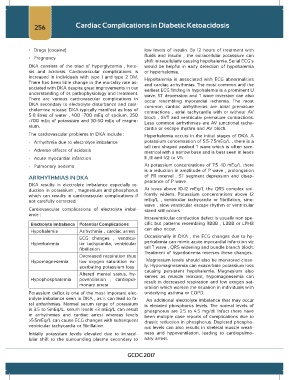
              Cardiovascular  complications  of electrolyte  imbal-  stand still occurs.
              ance :
                                                                 Intraventricular conduction defect is usually non spe-
               Electrolyte Imbalance Potential Complications     cific  but  patterns resembling RBBB , LBBB  or LPHB
                                                                 can also occur.
               Hypokalemia          Arrhythmia , cardiac arrest
                                    ECG  changes , ventricu-     Occasionally  in DKA  , the  ECG  changes  due to hy-
               Hyperkalemia         lar  tachycardia,  ventricular   perkalemia can mimic acute myocardial infarction viz
                                    fibrillation                 tall T wave , QRS widening and bundle branch block.
                                                                 Treatment of hyperkalemia reverses these changes.
                                    Decreased  respiration  thus
               Hypomagnesemia       low  oxygen  saturation ex-   Magnesium levels should also be monitored close-
                                    acerbating potassium loss    ly. Hypomagnesemia can exacerbate potassium loss
                                                                 causing persistent  hypokalemia.  Magnesium also
                                    Altered  mental status,  hy-  serves  as muscle  relaxant, hypomagnesemia can
               Hypophosphatemia     poventilation , cardiopul-   result  in  decreased  respiration  and low  oxygen  sat-
                                    monary arrest
                                                                 uration which worsen the situation in individuals with
              Potassium deficit is one of the most important elec-  underlying asthma or COPD.
              trolyte imbalance seen in DKA , as it can lead to fa-   An additional electrolyte imbalance  that  may occur
              tal arrhythmias. Normal  serum range  of potassium   is  elevated phosphorus  levels.  The normal levels  of
              is 3.5 to 5mEq/L. serum levels <3 mEq/L can result   phosphorus  are  2.5  to 4.5  mg/dl.  Infact  there  have
              in arrhythmias and cardiac  arrest  whereas  levels   been multiple case reports  of complications  due to
              >5.5mEq/L can cause ECG changes with subsequent    drastic reduction in phosphorus. Depleted phospho-
              ventricular tachycardia or fibrillation.           rus levels can  also results in skeletal muscle weak-
              Initially potassium  levels  elevated due to intracel-  ness  and hypoventilation,  leading  to cardiopulmo-
              lular shift to the surrounding plasma secondary to   nary arrest.


                                                         GCDC 2017

