


Page 275 - fbkCardioDiabetes_2017
P. 275
Diabetic  Dysrhythmias                                      251


                 products; AGEs)  interact with their  receptors (RAGE)
                 and upregulate  the connective  tissue  growth  factor
                 (CGTF). This system (AGERAGE) may start or contrib-
                 ute to atrial fibrosis  in diabetic patients via stimula-
                 tion of connective  tissue  growth factor in the atrial
                 myocardium .
                            9
                 Several clinical and electrophysiological studies have
                 demonstrated DCAN  to play  significant role  in the
                              10
                 genesis of AF .
                 Atrial  electrical  structure is  also  affected in diabetic
                 patients. Shortened atrial  effective refractory  period
                 (AERP), increased dispersion of AERP, inter and intra
                 atrial conduction time, which are the key elements of
                 atrial electrical remodelling  have  been documented.
                          11
                 Chao et  al   analyzed the detailed  three dimensional
                 electro  anatomic  mapping  of  228 patients who has
                 DM or abnormal glucose metabolism (AGM) and un-
                 derwent AF ablation for the first time. Results showed
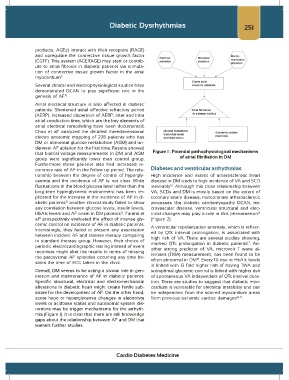
                 that biatrial voltage measurements in DM and AGM   Figure 1 : Potential pathophysiological mechanisms
                 group  were  significantly lower  than  control group.         of atrial fibrillation in DM
                 Furthermore these patients also had  increased re-
                 currence rate of AF in the follow up period. The rela-  Diabetes and ventricular arrhythmias
                 tionship between the degree of control of hypergly-  High  incidence and extent of atherosclerotic heart
                 caemia  and  the incidence  of AF is not  clear. While   disease in DM leads to high incidence of VA and SCD
                 fluctuations in the blood glucose level rather than the   inevitably . Although this close relationship between
                                                                            15
                 long-term  hyperglycemic  environment has been  im-  VA, SCDs and DM is mostly based on the extent of
                 plicated for the increase in the incidence of AF in di-  coronary artery disease, non coronary atherosclerotic
                              12
                 abetic patients  another clinical study failed to show   processes  like diabetic cardiomyopathy DCAN, mi-
                 any correlation between glucose levels, insulin levels,   crovascular disease,  ventricular structural  and elec-
                 HbA1c levels and AF onset in DM patients . Fatemi et   trical changes may play a role in this phenomenon
                                                                                                                   16
                                                      13
                  14
                 al  prospectively evaluated the affect of intense gly-  (Figure 2).
                 cemic control on incidence of AF in diabetic patients.   A ventricular repolarization anomaly, which is reflect-
                 Interestingly,  they failed to present  any association   ed by QTc interval prolongation,  is  associated with
                 between incident AF and intense therapy comparing   high risk  of VA. There  are several  studies showing,
                 to standard therapy group. However, their choice of   marked QTc prolongation  in diabetic  patients . An-
                                                                                                              17
                 periodic electrocardiographic testing instead of event   other strong predictor  of VA, microvolt  T wave al-
                 recorders might alter the results in terms of missing   ternans (TWA)  measurement, has been  found to be
                 the paroxysmal AF episodes occurring any time be-  often abnormal in DM . Every 1% rise in HbA1c levels
                                                                                        18
                 sides the time of ECG taken in the clinic.
                                                                    is linked with 13 fold higher risk of having TWA and
                 Overall, DM seems to be acting a pivotal role in gen-  suboptimal glycemic control is linked with higher risk
                 eration and maintenance  of AF  in diabetic patients.   of spontaneous VA independent of QTc interval dura-
                 Specific structural,  electrical and  electromechanical   tion. There are studies to suggest that diabetic myo-
                 alterations in diabetic heart might create fertile sub-  cardium is vulnerable for electrical instability and can
                 strate for the development of AF. On the other hand,   be independent from the scarred myocardium areas
                 acute  hypo  or  hyperglycemia  changes in electrolyte   from previous ischemic cardiac damages 15,17 .
                 levels or acid base status and autonomic system dis-
                 tortions may be trigger mechanisms for the arrhyth-
                 mia (Figure 1). It is clear that there are still knowledge
                 gaps about the relationship between AF and DM that
                 warrant further studies.


                                                    Cardio Diabetes Medicine

