


Page 35 - fbkCardioDiabetes_2017
P. 35
Cardio Diabetes Medicine 2017                                     11


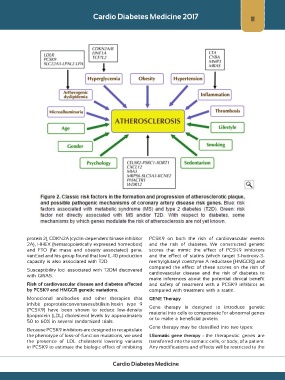
            protein 2), CDKN2A (cyclin-dependent kinase inhibitor   PCSK9  on both  the  risk  of cardiovascular  events
            2A), HHEX (hematopoietically expressed homeobox)   and the  risk  of  diabetes.  We  constructed  genetic
            and FTO (fat  mass and obesity  associated) gene.   scores  that  mimic the effect  of PCSK9  inhibitors
            vanExel and his group found that low IL-10 production   and  the  effect  of statins  (which  target 3-hydroxy-3-
            capacity is also associated with T2D               methylglutaryl–coenzyme A reductase [HMGCR]) and
                                                               compared the effect of these scores  on the risk  of
            Susceptibility  loci associated with  T2DM discovered   cardiovascular  disease  and  the risk  of diabetes to
            with GWAS.
                                                               make  inferences  about the potential clinical benefit
            Risk of cardiovascular disease and diabetes affected   and safety  of  treatment  with a PCSK9 inhibitor as
            by PCSK9 and HMGCR genetic variations.             compared with treatment with a statin.
            Monoclonal antibodies  and  other  therapies  that   GENE Therapy
            inhibit proproteinconvertasesubtilisin–kexin  type  9
            (PCSK9)  have been shown to reduce low-density     Gene therapy is designed  to introduce  genetic
            lipoprotein (LDL) cholesterol levels by approximately   material into cells to compensate for abnormal genes
            50 to 60% in several randomized trials.            or to make a beneficial protein.
                                                               Gene therapy may be classified into two types:
            Because PCSK9 inhibitors are designed to recapitulate
            the phenotype of loss-of-function mutations, we used   1.Somatic  gene  therapy -  the therapeutic genes  are
            the presence  of LDL  cholesterol–lowering  variants   transferred into the somatic cells, or body, of a patient.
            in PCSK9 to estimate the biologic effect of inhibiting   Any modifications and effects will be restricted to the


                                                Cardio Diabetes Medicine

