


Page 372 - fbkCardioDiabetes_2017
P. 372
348                   Pitfalls in Computer ECG Interpretations


              on the same person recorded 15 seconds apart may   mendation  reads: “Computer-based interpretation
              have  different interpretations either because of dif-  of the ECG is an adjunct to the electrocardiographer,
              ferent noise levels or because physiological variation   and all computer-based reports require physician over
              (e.g. respiratory cycle) means a diagnostic threshold   reading.
              has been crossed. Between the two ECGs one com-
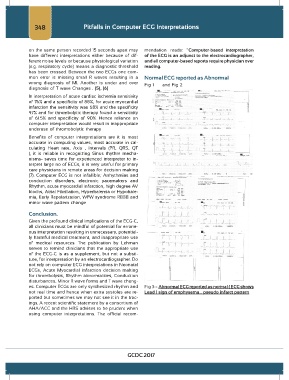
              mon  error  is  missing  small R waves resulting  in a  Normal ECG reported as Abnormal
              wrong diagnosis  of MI. Another is  under and  over   Fig 1    and Fig 2
              diagnosis of T wave Changes . (5), (6)
              In interpretation of acute cardiac ischemia sensitivity
              of 76% and a specificity of 88%, for acute myocardial
              infarction the sensitivity was 68% and the specificity
              97% and for thrombolytic therapy found a sensitivity
              of  61.5% and specificity  of  90%.  Hence  reliance  on
              computer interpretation would result in inappropriate
              underuse of thromobolytic therapy
              Benefits of computer interpretations are it is most
              accurate in computing values, most accurate in cal-
              culating Heart  rate,  Axis  ,  intervals  (PR, QRS, QT
              ), it is  reliable  in recognizing  Sinus rhythm  mecha-
              nisms- saves time for experienced interpreter  to in-
              terpret large no of ECGs, it is very useful for primary
              care physicians in remote areas for decision making
              (7).  Computer  ECG is  not infallible;  Arrhythmias  and
              conduction  disorders,  electronic pacemakers  and
              Rhythm, acute myocardial infarction, high degree AV
              blocks, Atrial Fibrillation, Hyperkalemia or Hypokale-
              mia, Early Repolarization, WPW syndrome RBBB and
              minor wave pattern change

              Conclusion.
              Given the profound clinical implications of the ECG-C,
              all clinicians must be mindful of potential for errone-
              ous interpretation resulting in unnecessary, potential-
              ly harmful medical treatment, and inappropriate use
              of medical resources.  The publication  by Lehman
              serves  to remind clinicians  that  the appropriate  use
              of the ECG-C is  as  a supplement,  but not a substi-
              tute, for interpretation by an electrocardiographer. Do
              not rely on computer ECG interpretations in Neonatal
              ECGs, Acute  Myocardial infarction  decision making
              for thrombolysis, Rhythm abnormalities, Conduction
              disturbances, Minor R wave forms and T wave chang-
              es. Computer ECGs are only synthesized rhythm and   Fig 3-- Abnormal ECG reported as normal ( ECG shows
              not real time and hence when extra systoles are re-  Lead 1 sign of emphysema,, pseudo infarct pattern
              ported but sometimes we may not see it in the trac-
              ings. A recent scientific statement by a consortium of
              AHA/ACC and the HRS advises to be prudent when
              using  computer  interpretations. The  official recom-


                                                         GCDC 2017

