


Page 375 - fbkCardioDiabetes_2017
P. 375
“Echocardiographic Evaluvation of A Diabetic Patient”                         351


                 Diabetic Cardiomyopathy                            Hypertension or Valvular heart disease .Three-dimen-
                                                                                                       7
                                                                    sional Echocardiographic stress imaging adds a new
                 The observation of frequent association of heart   dimension.
                 failure and  Diabetes was made by Leyden  et al in
                 1881 . However, it was Rubler in 1972, who introduced
                    5
                 the term Diabetic Cardiomyopathy . The minimal cri-  Diastolic function in Diabetic
                                                6
                 teria  to diagnose  Diabetic Cardiomyopathy  include   Cardiomyopathy
                 1. Concentric  Left Ventricular Hypertrophy  with   Abnormal E/A and  Deceleration  time:  Abnormal re-
                 LV diastolic dysfunction  and  Interstitial fibrosis   laxation characterised  by  decreased  E/A  ratio and
                 2. Eccentric  Dilated Cardiomyopathy with  re-     prolonged  Deceleration time and  Restrictive pattern
                 duced    left   ventricular  systolic   function   with increased E/A ratio and decreased Deceleration
                 independent of Coronary  Artery  Disease,  Systemic   time are well described in early studies 8
                 Abnormal E/e’ Ratio:
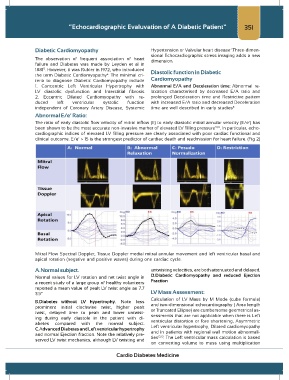
                 The ratio of early diastolic flow velocity of mitral inflow (E) to early diastolic mitral annular velocity (E/e′) has
                 been shown to be the most accurate non-invasive marker of elevated LV filling pressure 9,10 . In particular, echo-
                 cardiographic indices of elevated LV filling pressure are clearly associated with poor cardiac functional and
                 clinical outcome. E/e′ > 15 is the strongest predictor of cardiac death and readmission for heart failure. (Fig 2)


                 Mitral Flow Spectral Doppler, Tissue Doppler medial mitral annular movement and left ventricular basal and
                 apical rotation (negative and positive waves) during one cardiac cycle.

                 A.Normal subject.                                  untwisting velocities, are both attenuated and delayed.

                 Normal values for LV rotation and net twist angle in   D.Diabetic Cardiomyopathy  and  reduced  Ejection
                 a recent study of a large group of healthy volunteers   Fraction
                 reported a mean value of peak LV twist angle as 7.7
                 3.5°                                               LV Mass Assessment:
                                                                    Calculation  of LV  Mass  by  M  Mode  (cube  formula)
                 B.Diabetes  without  LV hypertrophy. Note less     and two-dimensional echocardiography ( Area length
                 prominent initial clockwise twist,  higher peak    or Truncated Ellipse) are cumbersome geometrical as-
                 twist, delayed  time to peak and lower  untwist-   sessments that are not applicable when there is Left
                 ing  during  early  diastole  in the patient with di-  ventricular distortion or fore shortening, Asymmetric
                 abetes  compared    with  the   normal   subject.   Left ventricular hypertrophy, Dilated cardiomyopathy
                 C.Advanced Diabetes and Left ventricular hypertrophy   and in patients with regional wall motion abnormali-
                 and normal Ejection fraction. Note the relatively pre-  ties 12,13 . The Left ventricular mass calculation is based
                 served LV twist mechanics, although LV twisting and
                                                                    on converting volume to mass  using  multiplication

                                                    Cardio Diabetes Medicine

