


Page 429 - fbkCardioDiabetes_2017
P. 429
Cardio Diabetes Medicine 2017                                   405


                 Demographics   Sulphonylureas (n= 154)  DPP4- inhibitors (n=153)  GLP-1 agonists (n=115)  SGLT-2 inhibitors (n=90)
                                Gliclazide    Glimepiride   Sitagliptin    Linagliptin    Exenatide    Liraglutide   Dapagliflozin (n=90)
                                (n=141)     (n=13)   (n=128)   (n=25)     (n=47)       (n=68)
                 Age            57.6        53.2     59        66         58.2         68       59.17
                 Men            46.8%       53.8%    52.3%     44%        48.9%        64.7%    58.9%
                 Women          53.2%       46.2%    47.7%     66%        51.1%        35.3%    41.1%
                 HbA1c mmol/mol  77.2       77.8     76.2      76.5       73.7         76.6     79.2
                 Weight (Kg)    82.9        88.9     86.2      89.1       100.8        101.9    97.6
                 BMI            28.5        30.2     29.3      30.7       34.5         34       32.9
                                       Table 1. Baseline information for patients prior to addition of new therapies.
                 Outcome     Time (Mo)  Sulphonylureas   DPP4 inhibitors   GLP-1 agonists   SLGT-2  inhibitors
                 measure              (n = 154)     (n=153)     (n=115)
                                      Gliclazide    Glimepiride   Sitagliptin    Linagliptin    Exenatide   Liraglutide   Dapagliflozin
                                      (n= 141)      (n=13)      (n=128)      (n=25)     (n=47)   (n=68)   (n=90)
                 HbA1c          0     77.27         77.78       76.18        76.52      73.72    76.59    71.18
                 (mmol/mol)     3     -9.48 *       -9.85 *     -6.59 *      -6.48 *    -7.32 *  -10.28 *  -8.97 *
                                12    -10.57 *      -6.62 *     -7.72 *      -7.4 *     -4.62 *  -10.10 *  -11.54 *
                 Weight (kg)    0     82.99         88.7        86.15        89.1       100.8    101.95   97.58
                                3     + 0.13        + 0.34      -0.47 *      -0.83 *    -2.57 *  -1.71 *  -1.96 *
                                12    + 0.37 *      + 0.02      -1.12 *      -0.95 **   -3.46 *  -2.47 *  -2.73 **
                 Table 2: Changes in HbA1c and weight at 3 and 12 months after initiation of additional therapies (* Significant difference
                        from baseline value , and ** Significant difference from baseline and between 3 and 12 months p<0.01)


                                                                    tenders, with whom the Physician reviewing the pa-
                                                                    tient prescribed  what  they felt was the most logical
                                                                    therapy on an individual basis. Comparisons between
                                                                    this study and pharmaceutical trial data, where there
                                                                    may be  a  more  careful selection of  the cohort in-
                                                                    volved, and different study lengths, should therefore
                                                                    be done with caution.
                                                                    Agents felt to reduce weight more from clinical trial
                                                                    data,  such as  the GLP-1  agonists  and SGLT-2  inhib-
                                                                    itors,  appear  to  have been  given  to patients with a
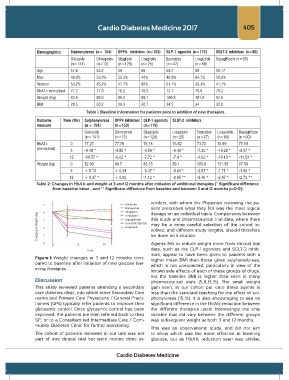
                 Figure 1:  Weight changes  at 3 and  12 months  com-  higher  mean BMI  than  those given  sulphonylureas,
                 pared to baseline after initiation of new glucose low-  which  is  not unexpected, particularly  in view of the
                 ering therapies
                                                                    known side effects of each of these groups of drugs,
                                                                    but  the  baseline  BMI  is  higher than  seen in many
                 Discussion                                         pharmaceutical  trials  (5,11,13,15). The  small  weight
                 This study reviewed  patients attending  a secondary   gain seen, in our cohort  put onto these agents is
                 care diabetes clinic, into which other Secondary Care   less than the standard teaching for the effect of sul-
                 teams and Primary Care Physicians / General Practi-  phonylureas (15,16).  It is also encouraging to see no
                 tioners (GPs) typically refer patients to improve their   significant difference in the HbA1c reduction between
                 glycaemic control. Once glycaemic control has been   the different  therapies  used.  Interestingly  the only
                 improved, the patients are then referred back to their   variable  that  did  vary  between  the different  groups
                 GP, or to a Consultant led Intermediate Care / Com-  was subsequent weight at both 3 and 12 months.
                 munity Diabetes Clinic for further monitoring.
                                                                    This  was an observational  study, and did  not aim
                 The  cohort  of  patients  reviewed  in  our  unit was  not   to show which  was the more  effective at lowering
                 part of any clinical  trial but  were  routine clinic  at-  glucose, but  as HbA1c reduction  seen was similar,


                                                    Cardio Diabetes Medicine

