


Page 434 - fbkCardioDiabetes_2017
P. 434
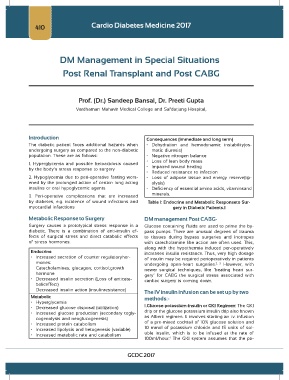
410                     Cardio Diabetes Medicine 2017


                           DM Management in Special Situations –


                             Post Renal Transplant and Post CABG


                                    Prof. (Dr.) Sandeep Bansal, Dr. Preeti Gupta
                                   Vardhaman Mahavir Medical College and Safdarjung Hospital,


              Introduction                                        Consequences (immediate and long term)
              The  diabetic patient faces additional hazards when   •  Dehydration  and hemodynamic  instability(os-
              undergoing surgery as compared to the non-diabetic    motic diuresis)
              population. These are as follows:                   •  Negative nitrogen balance
                                                                  •  Loss of lean body mass
              1. Hyperglycemia and possible  ketoacidosis  caused
              by the body’s stress response to surgery            •  Impaired wound healing
                                                                  •  Reduced resistance to infection
              2. Hypoglycemia due to peri-operative  fasting wors-  •  Loss  of adipose  tissue and energy  reserve(lip-
              ened by the prolonged action of certain long acting   olysis)
              insulins or oral hypoglycemic agents.               •  Deficiency of essential amino acids, vitaminsand
              3. Peri-operative  complications  that  are  increased   minerals.
              by diabetes, e.g.  incidence  of wound  infections  and   Table 1: Endocrine and Metabolic Responseto Sur-
              myocardial infarctions                                         gery in Diabetic Patients.1

              Metabolic Response to Surgery                      DM management Post CABG-
              Surgery  causes a prototypical stress  response  in a   Glucose containing  fluids  are  used  to prime  the by-
              diabetic. There is  a combination of anti-insulin ef-  pass  pumps.  There  are  unusual degrees  of trauma
              fects of surgical stress  and direct catabolic  effects   to tissues  during bypass  surgeries  and  inotropes
              of stress hormones.                                with catecholamine like  action  are  often used.  This,
                                                                 along with  the hypothermia induced  per-operatively
               Endocrine                                         increases insulin resistance. Thus, very high dosage
               •  Increased secretion of counter regulatoryhor-  of insulin may be required perioperatively in patients
                 mones:                                          undergoing open-heart surgeries. 2, 3  However,  with
                 Catecholamines; glucagon; cortisol;growth       newer  surgical  techniques, like  ‘beating heart sur-
                 hormone                                         gery’  for  CABG the surgical  stress  associated with
               •  Decreased insulin secretion (Loss of anticata-  cardiac surgery is coming down.
                 boliceffect)
                 Decreased insulin action (insulinresistance)
                                                                 The IV insulin infusion can be set up by two
               Metabolic                                         methods:-
               •  Hyperglycemia
               •  Decreased glucose disposal (utilization)       I.Glucose-potassium-insulin or GKI Regimen: The GKI
               •  Increased glucose production  (secondary togly-  drip or the glucose potassium insulin drip also known
                 cogenolysis and neoglucogenesis)                as Alberti regimen. It involves starting an i.v. infusion
               •  Increased protein catabolism                   of a pre-mixed cocktail of 10% glucose solution and
               •  Increased lipolysis and ketogenesis (variable)  10 mmol of potassium chloride and 15 units of sol-
               •  Increased metabolic rate and catabolism        uble insulin, which  is  to be infused at  the  rate of
                                                                 100ml/hour.  The GKI system  assumes  that  the pa-
                                                                            4


                                                         GCDC 2017

