


Page 436 - fbkCardioDiabetes_2017
P. 436
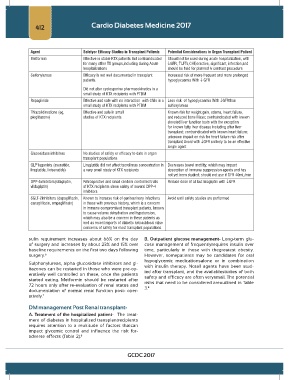
412                     Cardio Diabetes Medicine 2017


               Agent                  Safetyor Efficacy Studies in Transplant Patients  Potential Considerations in Organ Transplant Patient
               Metformin              Effective in stable KTX patients But contraindicated   Should not be used during acute hospitalization, with
                                      for many other TX groups,including during Acute   ↓GFR, ↑LFTs,CHF,oractive, significant, infection;and
                                      hospitalizations                     should be held for planned iv contrast procedure
               Sulfonylureas          Efficacy is not well documented in transplant   Increased risk of more frequent and more prolonged
                                      patients.                            hypoglycaemia With ↓ GFR

                                      Did not alter cyclosporine pharmacokinetics in a
                                      small study of KTX recipients with PTDM
               Repaglinide            Effective and safe with no interaction  with CNIs in a  Less risk  of hypoglycaemia With ↓GFRthan
                                      small study of KTX recipients with PTDM  sulfonylureas
               Thiazolidinedione (eg,   Effective and safe in small        Known risk for weight gain, edema, heart failure,
               pioglitazone)          studies of KTX recipients            and reduced bone Mass; contraindicated with known
                                                                           elevated liver function tests with the exception
                                                                           for known fatty liver disease including after liver
                                                                           transplant; contraindicated with known heart failure;
                                                                           unknown impact on risk for heart failure risk after
                                                                           transplant Avoid with ↓GFR unlikely to be an effective
                                                                           single agent
               Glucosidase inhibitors  No studies of safety or efficacy to date in organ
                                      transplant populations
               GLP1agonists (exenatide,   Liraglutide did not affect tacrolimus concentration in  Decreases bowel motility, which may impact
               liraglutide, lixisenatide)  a very small study of KTX recipients  absorption of immune suppression agents and has
                                                                           not yet been studied; should not use if GFR 40mL/min
               DPP-4inhibitors(sitagliptin,   Retrospective and small random controlled trials   Reduce dose of all but linagliptin with ↓GFR
               vildagliptin)          of KTX recipients show safety of several DPP-4
                                      inhibitors
               SGLT-2inhibitors (dapagliflozin,  Known to increase risk of genitourinary infections   Avoid until safety studies are performed
               canagliflozin, empagliflozin)  in those with previous history, which is a concern
                                      in immune compromised transplant patients, known
                                      to cause volume dehydration and hypotension,
                                      which may also be a concern in these patients as
                                      well as recent reports of diabetic ketoacidosis raise
                                      concerns of safety for most transplant populations

              sulin requirement  increases about  66%  on the  day   B. Outpatient  glucose  management-  Long-term  glu-
              of surgery and increases by about 23% and 15% over   cose management of frequentlyrequires insulin over
              baseline requirements on the first two days following   time, particularly  in those with  thegreatest obesity.
              surgery. 6                                         However,  somepatients  may  be  candidates for  oral
                                                                 hypoglycemic medicationsalone  or in combination
              Sulphonylureas, alpha glucosidase inhibitors and gl-
              itazones can be restarted in those who were pre-op-  with insulin therapy.  Notall  agents have been stud-
              eratively  well  controlled  on these,  once the patients   ied after transplant, and the availablestudies of both
              started  eating.  Metformin  should be  restarted  after   safety and efficacy are often verysmall. The potential
              72 hours only after re-evaluation of renal status and   risks that need to be considered areoutlined in Table
                                                                  8
              documentation  of normal renal  function  post-  oper-  3.
              atively. 7

              DM management Post Renal transplant-
              A. Treatment  of the  hospitalized  patient-    The  treat-
              ment of diabetes in hospitalized transplantrecipients
              requires  attention to a multitude  of factors thatcan
              impact  glycemic control  and influence  the  risk  for-
              adverse effects (Table 2). 8


                                                         GCDC 2017

