


Page 451 - fbkCardioDiabetes_2017
P. 451
Cardio Diabetes Medicine 2017                                   427


                 els with pre-existing type 2 diabetes. to the fetus, a   benefits of tight glycemic control on macrovascular
                 process termed “facilitated anabolism”.            disease seem to become more evident with time, the
                                                                    so-called “legacy effect” or “metabolic memory”.
                 It is advisable to select more stringent targets for
                 pregnant  women with pre-existing  type  2 diabetes
                 and  gestational diabetes (FBG < 90  mg/dL,  1-h PP   HYPERGLYCEMIA AND DIABETIC
                 < 130  mg/dL,  and  2-h PP < 110  mg/dL) while more  RETINOPATHY
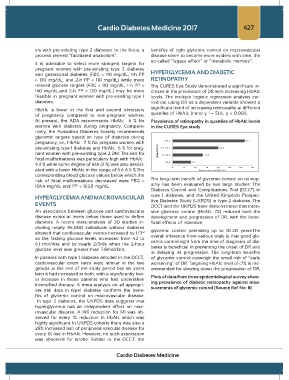
                 relaxed  glucose  targets  (FBG <  90 mg/dL,  1-h PP  <   The CURES Eye Study demonstrated a significant in-
                 140 mg/dL,and  2-h PP  <  120 mg/dL)  may  be  more   crease in the prevalence of DR with increasing HbA1c
                 feasible  in pregnant women  with pre-existing type  1   levels.  The multiple  logistic  regression  analysis  car-
                 diabetes.                                          ried out using DR as a dependent variable showed a
                                                                    significant trend of increasing retinopathy at different
                 HbA1c  is  lower  in  the first  and second trimesters                      2
                 of pregnancy compared to non-pregnant women.       quartiles of HbA1c (trend χ   = 51.6, p < 0.001).
                 At  present,  the  ADA  recommends  HbA1c  ≤  6  %  for   Prevalence of retinopathy in quartiles of HbA1c levels
                 women  with  diabetes during pregnancy. Compara-   in the CURES Eye study
                 tively,  the Australian  Diabetes  Society  recommends
                 glycemic targets  based on type  of diabetes during
                 pregnancy, i.e., HbA1c ≤ 7 % for pregnant women with    <10.3                               31.7
                 pre-existing type 1 diabetes and HbA1c ≤ 6 % for preg-  8.5-10.3                 20.0
                 nant women with pre-existing type 2 DM. The risk for   Quartiles of HbA1c (%)  6.9-8.4  13.3
                 fetal malformations was particularly high with HbA1c ≥
                                                                          >6.9        8.1
                 9.3 % while some degree of risk (3 %) was also associ-
                                                                             0    5    10   15   20   25   30   35
                 ated with a lower HbA1c in the range of 5.6–6.5 %.The                   Prevalence of DR (%)
                 corresponding blood glucose values below which the
                 risk  of fetal malformations decreased  were  FBG  <   The long-term benefit of glycemic control on retinop-
                 104.4 mg/dL and PP < 163.8 mg/dL                   athy has been evaluated  by two large  studies: The
                                                                    Diabetes Control  and  Complications  Trial  (DCCT)  in
                 HYPERGLYCEMIA AND MACROVASCULAR                    type  1 diabetes, and  the  United Kingdom Prospec-
                                                                    tive Diabetes Study (UKPDS) in type 2 diabetes. The
                 EVENTS                                             DCCT and the UKPDS have demonstrated that inten-
                 An association between glucose and cardiovascular   sive  glycemic  control  (HbA1c  ≤7%)  reduced  both  the
                 disease  exists  at levels  below  those used  to define   development and progression of DR, with the bene-
                 diabetes.  A  recent  meta-analysis of 20 studies  in-  ficial effects of intensive
                 cluding nearly  96,000  individuals  without  diabetes   glycemic  control persisting  up  to 10–20 years.The
                 showed that cardiovascular events increased by 1/3    overall inference from various trials is that good gly-
                                                                rd
                 as  the fasting glucose  levels  increased  from 4.2 to   cemic control right from the time of diagnosis of dia-
                 6.1 mol/litre  and by  nearly  2/3rds  when the 2-hour   betes is beneficial in preventing the onset of DR and
                 glucose level was greater than 7.8mol/litre.
                                                                    in delaying  its progression.  The long-term benefits
                 In patients with type 1 diabetes enrolled in the DCCT,   of glycemic control outweigh the small risk of “early
                 cardiovascular  event rates  were  similar  in the two   worsening” of DR. Targeting HbA1c level of<7% is rec-
                 groups at the end of the study period but six years   ommended for slowing down the progression of DR.
                 later it had increased in both, with a significantly low-
                 er  increase in those patients who  had  undertaken   Plots of data from three epidemiological survey show-
                 intensified therapy. A meta-analysis on all appropri-  ing  prevalence of diabetic retinopathy against  mea-
                 ate trial  data  in type1  diabetes confirms the bene-  surements of glycemic control (Source Ref No: 8)
                 fits  of  glycemic control on macrovascular  disease.
                  In type 2 diabetes, the UKPDS data  suggests  that
                 hyperglycemia  has an  independent effect on mac-
                 rovascular disease.  A  14% reduction for  MI  was ob-
                 served  for  every  1% reduction in HbA1c  which  was
                 highly significant. In UKPDS cohorts there was also a
                 28% increased risk of peripheral vascular disease for
                 every 1% rise in HbA1c. However, no such association
                 was observed  for stroke.  Similar  to the DCCT,  the


                                                    Cardio Diabetes Medicine

