


Page 452 - fbkCardioDiabetes_2017
P. 452
428                  Glycemic Control- How Tight It Should Be?


                                                                 HYPERGLYCEMIA AND DIABETIC
                                                                 NEUROPATHY
                                                                 Diabetic  neuropathy complicates both  type  1 and
                                                                 type  2 diabetes.  Diabetic peripheral  and autonomic
                                                                 neuropathies are common  complications  of diabe-
                                                                 tes with a broad spectrum of clinical manifestations
                                                                 and high  morbidity.  Among  peripheral  neuropathies
                                                                 in diabetes, the most studied in clinical trials is dis-
                                                                 tal symmetrical sensory motor polyneuropathy (DSP),
                                                                 and among autonomic neuropathies, the most stud-
                                                                 ied is cardiovascular  autonomic  neuropathy (CAN).
                                                                 The lack  of standardized,  validated measures  for
                                                                 DSP and CAN in most large trials limits the interpre-
                                                                 tations of the data.  DCTT/ EDIC and other smaller
                                                                 trials  strongly demonstrated that  intensive control
                                                                 designed to achieve near normoglycemia is essential
                                                                 to delaying the progression of DSP and CAN in T1D.
                                                                 The effect of glycemic control on DSP and CAN are
                                                                 less conclusive for T2D.
                                                                 CONCLUSIONS
                                                                 •  In spite of the advent of newer therapeutic modal-
              HYPERGLYCEMIA AND DIABETIC                           ities for diabetes, glycemic control  remains chal-
              NEPHROPATHY                                          lenging.
              Diabetes  mellitus  is  the major  cause of  end  stage   •  By keeping glycemia under control, several compli-
              renal  disease  (ESRD)  throughout  the world.  Diabet-  cations can be prevented or at the least, delayed.
              ic nephropathy does not develop in all patients with   •  Glycemic control can be achieved not only by tak-
              diabetes and it is believed to be progressive disease   ing drugs, but also through proper life style man-
              from microalbuminuria  to macroalbuminuria  and      agement.
              ESRD. The  diagnosis  of  diabetic nephropathy  can
              be made by the persistent  presence  of albumin  in   •  Tight glycemic control early on in the natural his-
              the urine,  or  continuous  rise  in  serum  creatinine, or   tory of diabetes has far-reaching  benefits for the
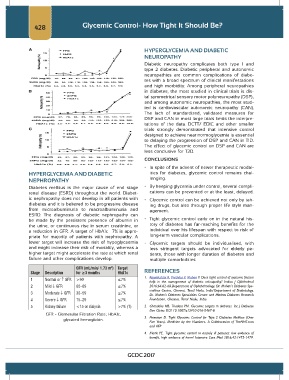
              a reduction in GFR. A target of HbA1c ≤ 7% is appro-  individual over his lifespan with respect to risk of
              priate  for  majority  of patients with  nephropathy. A   long-term vascular complications.
              lower  target  will  increase  the risk  of  hypoglycaemia   •  Glycemic  targets should be individualised, with
              and might increase their risk of mortality, whereas a   less  stringent targets advocated  for elderly  pa-
              higher target might accelerate the rate at which renal   tients, those with longer duration of diabetes and
              failure and other complications develop.             multiple comorbidities.

                                                  2
                                   GFR (mL/min/ 1.73 m )   Target
               Stage  Description  for ≥3 months     HbA1c       REFERENCES
                                                                 1.  Rajalakshmi R, Prathiba V, Mohan V. Does tight control of systemic factors
               1     Normal or ↑ GFR  >90            ≤7%           help  in  the  management of diabetic  retinopathy?  Indian J Ophthalmol
               2     Mild ↓ GFR    60–89             ≤7%           2016;64:62-68.Department of Ophthalmology, Dr. Mohan’s Diabetes Spe-
                                                                   cialities  Centre, Chennai, Tamil Nadu, India Department of Diabetology,
                                                                                               1
               3     Moderate ↓ GFR  30–59           ≤7%           Dr. Mohan’s Diabetes Specialties Centre and Madras Diabetes Research
               4     Severe ↓ GFR  15–29             ≤7%           Foundation, Chennai, Tamil Nadu, India
               5     Kidney failure  <15 or dialysis  >7% (?)    2.  Chandalia HB, Thadani PM. Glycemic targets in diabetes. Int J Diabetes
                                                                   Dev Ctries DOI 10.1007/s13410-016-0467-8
                     GFR - Glomerular Filtration Rate; HbA1c,
                             glycated hemoglobin.                3.  Newman D. Tight Glycemic  Control for Type 2 Diabetes  Mellitus  (Over
                                                                   Five Years). Medicine  by the Numbers- A Collaboration  of TheNNT.com
                                                                   and AFP
                                                                 4.  Marik PE. Tight glycemic control  in acutely  ill  patients:  low evidence  of
                                                                   benefit, high evidence of harm! Intensive Care Med 2016;42:1475-1479.


                                                         GCDC 2017

