


Page 54 - fbkCardioDiabetes_2017
P. 54
30                           Cardio Diabetes Medicine 2017


                     The New Brave World of Dyslipidemia :


                       Ready to Target ASCVD after Statins


                                                    Dr. P. C. Manoria,
                                                   MD., DM., FSACC., FESC.,
                                         Director menoria Heart and critical care Hospital,
                                         Former Prof and H.O.D Cardiology GMC,Bhopal.


              Abstract                                           is therefore poised  to  improve compliance  greatly
              With  kicking off of second revolution of PCSK9  in-  compared to PCSK9  MoAbs.  It is  obviously emerg-
              hibition by fully  humanized MoAbs  after the statin   ing as a very important competitor to PCSK9 MoAbs.
              revolution, we are amidst a new brave world of dyslip-  The future ongoing trials will tell us more about this
              idemia which is ready to target atherosclerotic cardio-  molecule.
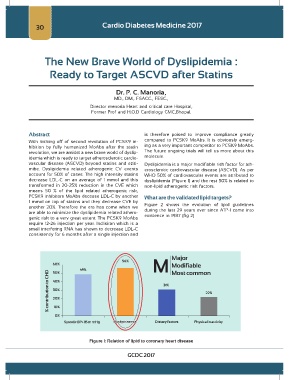
              vascular  disease (ASCVD)  beyond statins  and  eziti-  Dyslipidemia is a major modifiable risk factor for ath-
              mibe. Dyslipidemia related  atherogenic CV events   erosclerotic cardiovascular disease (ASCVD). As per
              account for 50% of cases. The high intensity statins   WHO 50% of cardiovascular events are attributed to
              decrease  LDL-C on an average  of 1 mmol and this   dyslipidemia (Figure 1) and the rest 50% is related to
              transformed in 20-25% reduction  in the CVE which   non-lipid atherogenic risk factors.
              means 50  % of  the lipid  related  atherogenic  risk,
              PCSK9 inhibitors MoAbs decease LDL-C by another    What are the validated lipid targets?
              1 mmol on top of statins and they decrease CVE by   Figure  2 shows the evolution of lipid  guidelines
              another 20%.  Therefore  the era  has come when we   during  the last 29 years ever  since ATP-1  came into
              are able to minimize the dyslipidemia related athero-  existence in 1987 (fig 2)
              genic risk to a very great extent. The PCSK9 MoAbs
              require 12-26 injection per year. Inclisiran which  is a
              small interfering RNA has shown to decrease LDL-C
              consistently for 6 months after a single injection and


                                        Figure 1: Relation of lipid to coronary heart disease


                                                         GCDC 2017

