


Page 56 - fbkCardioDiabetes_2017
P. 56
32                           Cardio Diabetes Medicine 2017


              this data is that sub-group analysis of ACCORD trial   reduction of CV events by 20-25% approximately ir-
              in patients with raised TG>204 mg/dL and low HDL-C   respective of baseline LDL-C. This means that statins
              <34 mg/dL did show a benefit but sub-group analysis   are powered to decrease 50 % of dyslipidemia related
              are only hypothesis generating and the finding needs   atherogenic risk.
              to be  confirmed in large  randomized trial  which  is   We have already  witnessed  the revolutionary  era
              non-existent at the present state of  time. Likewise   of statins for last 30  years  and  indeed statins  have
              in the meta-analysis  of fibrate  trials , fibrates were   emerged as uncontested king for lipid management.
                                                6
              not used on top of statins in all trials. It is important   We have  voluminous  data  on statins  and  they are
              to realize that it is apoB particles which  enters the   class IA recommendation for primary as well as sec-
              vessel wall and not TG per se. The risk of atheroscle-  ondary  prevention  of  coronary  artery  disease.  They
              rosis is related to the number of atherogenic particles   are highly effective  drugs  and  have  minimal  side
              and each atherogenic lipoprotein particle contains a   effects. 2015 came with breaking  news when two
              single molecule of apoB. Therefore the concentration   PCSK9 inhibitors, evolocumab and alirocumab were
              of apoB provides a direct measure of the number of   approved  for  clinical use  by  EMA  and ACC/AHA.
              circulating atherogenic lipoprotein. In most hypertrigl-  With  this a new revolutionary era of PCSK9  has
              ceridemic (HyperTG) patients including diabetics, LDL   erupted and this kicked off the second revolution in
              particles make up 85-90% of total apoB  particles and   dyslipidemia  after  the Statins. PCSK9 inhibitors  de-
              the contribution of VLDL is only 10-15%. Fibrates only   crease LDL-C by another 1 mmol and this is expected
              lower  LDL particle by only about  10%  and  therefore   to decrease CVE by another 20-25%. Therefore with
              fibrates at most may only play a minor role. The Que-  combination  of  both drugs  the dyslipidemia  related
              bec cardiovascular study also  showed  that  if  there   atherogenecity can  be minimized to a great  extent.
              is  HyperTG  with normal apoB  levels,  there  is  no in-  The  effect of reduction in LDL-C on cardiovascular
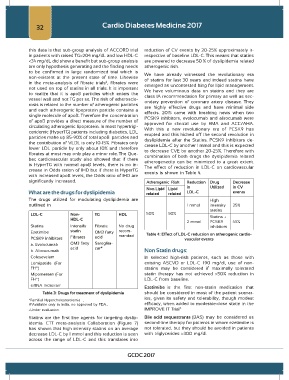
              crease in Odds ration of IHD but if there is HyperTG   events is shown in Table 4.
              with increased apoB levels, the Odds ratio of IHD are
              significantly increased.                            Atherogenic  Risk  Reduction  Drug    Decrease
                                                                  Non Lipid  Lipid   in       Utilized  in CV
              What are the drugs for dyslipidemia                 related  related  LDL-C               events
              The drugs  utilized for modulating  dyslipidemia  are                           High
              outlined in                                                          1 mmol     intensity   25%
                                                                                              statins
               LDL-C            Non-       TG        HDL          50%      50%                Statins +
                                HDL-C
                                                                                   2 mmol     PCSK9     45%
               Statins          Intensify   Fibrate  No drug                                  inhibitors
               Ezetimibe        statin     OM3 fatty   recom-     Table 4: Effect of LDL-C reduction on atherogenic cardio-
               PCSK9 inhibitors  Fibrates  acid      mended                       vascular events
               a. Evolocumab    OM3 fatty   Saroglita-
                                             #
               b. Aliorocumab   acid       zar                   Non Statin drugs:
               Colesevelam                                       In selected high-risk  patients, such as  those  with
               Lomipatide  (For                                  existing  ASCVD  or  LDL-C  ≥190  mg/dl,  use  of  non-
               FH*)                                              statins may be considered  if maximally tolerated
               Mipomersen (For                                   statin therapy  has not achieved >50% reduction in
               FH*)                                              LDL-C from baseline.
               siRNA Inclisiran   +
                                                                 Ezetimibe  is  the first  non-statin medication  that
                    Table 3: Drugs for treatment of dyslipidemia  should be considered in most of the patient scenar-
                                                                 ios, given its safety and  tolerability, though  modest
              *Familial Hypercholesterolemia  ,
              #Available only in India, no approved by FDA.,       efficacy, when added to moderate-dose statin in the
                                                                                7.
              +Under evaluation.                                 IMPROVE IT Trial
              Statins are  the first line agents for targeting dyslip-  Bile  acid  sequestrants  (BAS) may be considered  as
              idemia. CTT meta-analysis Collaboration (Figure  7)   second-line therapy for patients in whom ezetimibe is
              has shown that high intensity statins on an average   not tolerated, but they should be avoided in patients
              decrease LDL-C by 1 mmol and this reduction is seen   with triglycerides >300 mg/dl.
              across the range of LDL-C and  this translates into


                                                         GCDC 2017

