


Page 549 - fbkCardioDiabetes_2017
P. 549
Integrated Management of                                     525
                                         Diabetes Through Novel Therapies


                 of the Islets of Langerhans. MSCs are known to pro-  F)-BB, and  angiopoietin-1,  also play  an  integral role
                 mote  the regeneration of pancreatic  islet  beta  cells,   in the process of cell regeneration.
                 protect  endogenous  pancreatic islet  beta cells  from   Type  1 Diabetes is  characterized  by  the action  of
                 apoptosis,  and ameliorate insulin resistance of pe-  b-cell-specific, autoreactive T-cells. Even if the regen-
                 ripheral  tissues  by  providing a supportive  niche mi-  erative properties of the pancreas remain functional,
                 croenvironment driven by the secretion of paracrine   the continued  presence  of  these  T-cells  effectively
                 factors or the deposition of extracellular matrix.
                                                                    counteracts any endogenous repair and would likely
                 The identification of stem cells that possess the po-  decimate populations of newly-regenerated or trans-
                 tential  to differentiate into insulin-producing cells   planted insulin-producing cells (5).
                 (IPCs), improve pancreatic regeneration, and amelio-  In addition to their regenerative  properties,  MSCs
                 rate insulin resistance  offers  an alternative to islet   have also  demonstrated an immunoregulatory ca-
                 cell transplant. The potential to differentiate into IPCs   pacity. MSCs are also known  as immunoprivileged
                 was first  considered  to be  the primary  mechanism   cells  because of  the low  intracellular  expression  of
                 by  which MSCs  ameliorate  hyperglycemia  in T2DM.   class  II  major  histocompatibility (MHC) proteins  and
                 (Fig 1)
                                                                    co-stimulatory molecules. MSCs suppress the prolif-
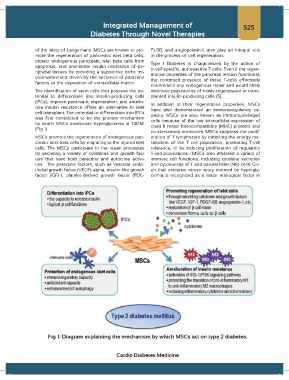
                 MSCs promote the regeneration of endogenous pan-   eration of T lymphocyte by inhibiting the energy me-
                 creatic islet beta cells by migrating to the injured islet   tabolism of the  T  cell  population, promoting  T-cell
                 cells.  The MSCs  participate  in the repair  processes   tolerance, or  by  inducing proliferation  of  regulatory
                 by  secreting  a variety  of cytokines  and growth fac-  T-cell  populations.    MSCs  also  inhibited a variety  of
                 tors that  have  both  paracrine and  autocrine  activi-  immune cell  functions,  including  cytokine  secretion
                 ties.    The paracrine factors,  such  as vascular  endo-  and cytotoxicity of T and natural killer (NK) cells. Giv-
                 thelial growth factor (VEGF)-alpha, insulin-like growth   en that  oxidative stress  injury induced  by hypergly-
                 factor  (IGF)-1,  platelet-derived growth factor  (PDG-  cemia is  recognized  as  a major  etiological  factor in


                      Fig 1: Diagram explaining the mechanism by which MSCs act on type 2 diabetes.


                                                    Cardio Diabetes Medicine

