


Page 593 - fbkCardioDiabetes_2017
P. 593
Cardio Diabetes Medicine 2017                                   569


                                                                    seemsunlikely that hyperglycemia does not increase
                                                                    Cardiovascular risk.  The  recent studies  included
                                                                    participants with  low potential for  reversing  estab-
                                                                    lished Cardiovascular disease and high risk of treat-
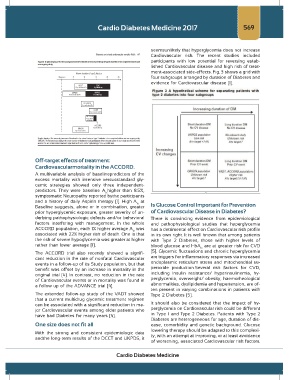
                                                                    ment-associated side-effects. Fig. 3 shows a grid with
                                                                    four subgroups arranged by duration of Diabetes and
                                                                    evidence for Cardiovascular disease [1].


                 Off-target effects of treatment:
                 Cardiovascularmortality in the ACCORD.
                 A multivariable analysis of baselinepredictors of the
                 excess  mortality with  intensive versusstandard gly-
                 cemic strategies  showed only  three  independent-
                 predictors.  They were  baseline A higher than  8.5%,
                                               1c
                 symptomatic Neuropathy reported bythe participants
                 and a history of daily Aspirin therapy [1]. High A  at
                                                             1c
                 Baseline  suggests, alone or in combination,  greater   Is Glucose Control Important for Prevention
                 prior hyperglycemic exposure, greater severity of un-  of Cardiovascular Disease in Diabetes?
                 derlying pathophysiologic defects and/or behavioral   There  is  convincing  evidence  from epidemiological
                 factors interfering  with management.  In the whole   and pathophysiological  studies  that  hyperglycemia
                 ACCORD population, each 1% higher average A  was   has a detrimental effect on Cardiovascular risk profile
                                                            1c
                 associated with 22% higher risk of death. One is that   in its own right. It is well known that among patients
                 the risk of severe hypoglycemia was greater at higher   with Type  2 Diabetes, those with higher  levels  of
                 rather than lower average [1].                     blood glucose and HbA  are at greater risk for CVD
                                                                                         1c
                 The ACCORD trial also  recently showed a signifi-  [5]. Glycemic fluctuations and chronic hyperglycemia
                 cant reduction in the rate of nonfatal Cardiovascular   are triggers for inflammatory responses via increased
                 events in a follow-up of its Study population, but that   endoplasmic reticulum stress and mitochondrial su-
                 benefit was offset by an increase in mortality in the   peroxide  production.Several risk  factors for  CVD,
                 original trial [4]. In contrast, no reduction in the rate   including  Insulin resistance/  hyperinsulinemia, hy-
                 of Cardiovascular events or in mortality was found in   perglycemia, overweight/ obesity, haemorheological
                 a follow up of the ADVANCE trial [4].              abnormalities, dyslipidemia and hypertension, are of-
                                                                    ten present in varying combinations in patients with
                 The extended follow-up study of the  VADT showed   Type 2 Diabetes [5].
                 that a current multidrug glycemic treatment regimen
                 can be associated with a significant reduction in ma-  It should also be considered  that  the impact  of hy-
                 jor Cardiovascular events among older patients who   perglycemia on Cardiovascular risk could be different
                 have had Diabetes for many years [4].              in Type 1 and  Type  2 Diabetes.  Patients  with  Type  2
                                                                    Diabetes are heterogeneous for age, duration of dis-
                 One size does not fit all                          ease, comorbidity and  genetic  background. Glucose
                                                                    lowering therapy should be adapted to this complexi-
                 With  the strong and  consistent  epidemiologic  data   ty, with an attempt at improving, or at least avoidance
                 andthe long-term results of the DCCT and UKPDS, it
                                                                    of worsening, associated Cardiovascular risk factors.


                                                    Cardio Diabetes Medicine

