


Page 638 - fbkCardioDiabetes_2017
P. 638
614              Medical Nutrition Therapy in Chronic Kidney Disease


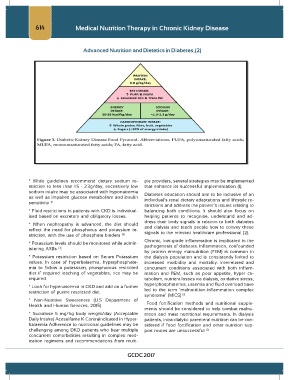
                                      Advanced Nutrition and Dietetics in Diabetes,(2)


              * While guidelines  recommend  dietary  sodium re-  ple providers, several strategies may be implemented
              striction to less  than  1.5–-  2.3g/day,  excessively  low   that enhance its successful implementation (1).
              sodium intake may be associated with hyponatremia   Diabetes education should aim to be inclusive of an
              as well as impaired glucose metabolism and insulin   individual’s renal dietary adaptations and lifestyle re-
                       (1)
              sensitivity
                                                                 strictions and address the patient’s issues relating to
              * Fluid restrictions in patients with CKD is individual-  balancing  both  conditions.  It should also focus  on
              ised based on excretory and obligatory losses.     helping  patients to recognise,  understand and ad-
                                                                 dress their body signals in relation to both diabetes
              *  When nephropathy is  advanced,  the diet should
              reflect  the need for  phosphorus  and potassium re-  and dialysis and teach people how to convey these
              striction, with the use of phosphate binders       signals to the relevant healthcare professional (2).
                                                       (5).
                                                                 Chronic, low-grade inflammation is implicated in the
              * Potassium levels should be monitored while admin-  pathogenesis of diabetes. Inflammation, confounded
              istering ARBs  .
                           (3)
                                                                 by  protein  energy  malnutrition (PEM) is  common  in
              *  Potassium restriction based on Serum Potassium   the  dialysis  population and  is consistently  linked to
              values. In case of hyperkalaemia,  hyperphosphate-  increased  morbidity  and mortality.  Interrelated  and
              mia to follow a potassium, phosphorous  restricted   concurrent  conditions associated with both inflam-
              diet  if  required  leaching of  vegetables,  rice  may be   mation  and PEM, such as  poor  appetite,  hyper  ca-
              required.                                          tabolism, nutrient losses via dialysis, oxidative stress,
                                                                 hyperphosphatemia, uraemia and fluid overload have
              * Look for hyperuricemia in CKD and add on a further
              restriction of purine restricted diet.             led  to the term ‘malnutrition-inflammation  complex
                                                                 syndrome’ (MICS)  (2)
              *  Non-Nutritive  Sweeteners  (U.S  Department of
              Health and Human Services, 2015)                    Food fortification methods and nutritional  supple-
                                                                 ments should be considered to help combat malnu-
              *  Sucralose  5  mg/kg  body weight/day  (Acceptable   trition and  meet nutritional  requirements.  In dialysis
              Daily Intake) Acesulfame K Contraindicated in Hyper-  patients, intra-dialytic parenteral nutrition can be con-
              kalaemia Adherence to nutritional guidelines may be   sidered  if  food  fortification and other nutrition  sup-
              challenging among DKD patients who bear multiple   port routes are unsuccessful   (2)
              concurrent  comorbidities  resulting in complex  med-
              ication regimens  and recommendations from  multi-


                                                         GCDC 2017

