


Page 642 - fbkCardioDiabetes_2017
P. 642
618              The Role of Lifestyle Modification in The Prevention of
                                            Diabetes and Cardiovascular Disease


              of T2DM and  CVD. The NICE [National  Institute for   Diet also  plays  an important role  in the prevention

              Health and  Care Excellence]  guidelines  recommend   of T2DM. The caloric content of food is more import-
              an initial weight loss target of 5 to 10%; ADA [Amer-  ant than its macronutrient content, in achieving and
              ican  Diabetes Association] recommends to achieve   maintaining the recommended weight loss by an in-
              and  maintain  a minimum  of 7%  weight loss  RSSDI   dividual.
                                                       ,
              [Research Society for the Study of Diabetes in India]   In prospective epidemiological studies, the glycaemic
              recommends a 5 to 10% reduction in body weight.
                                                                 index and the glycaemic load of the food were asso-
              It is noteworthy that  any unintended  weight loss   ciated with an increased risk of T2DM in both sexes.
              needs  to be differentiated from intentional  weight   Diets which contain high starch, low-fibre and with a
              loss  through the  efforts of the  patient.  This is be-  high ‘starch-to-cereal fibre ratio’ are associated with
              cause unintentional weight  loss  may  be  an adverse   an increased risk of T2DM.
              indicator pointing towards poor management of dia-  Consumption of  dietary  fibre  reduces  the risk  of
              betes, poor compliance and poor glycaemic control.
                                                                 diabetes and  research  evidence strongly  supports
              Diet:                                              this. For  example,  in  the Finnish Diabetes  Preven-
                                                                 tion study (Finnish DPS), consumption of ≥ 15g / 1000
              Diet is  one  of  the cornerstones  in the treatment of   kcal of fibre in the diet reduced the risk of diabetes.
              DM. Dietary recommendations for patients with dia-  Thus, professional guidelines recommend increasing
              betes  focus on glycaemic  control  and reducing  the   the intake  of dietary  fibre  to reduce the risk  of de-
              risk  of  developing  the co-morbidities  of  diabetes  &   veloping diabetes. Diets high in fibre content reduce
              the risk  of  CVD and other  complications of  diabe-  fasting blood glucose levels and LDL-C levels in pa-
              tes.  In  individuals  with diabetes,  various  patterns  of   tients with DM.Dietary fibre also seems to be protec-

              dietary management have been tried. These include   tive against CVD as seen in epidemiological studies.
              low-carbohydrate diet, low-glycaemic index diet, low-  However,  information  from randomised controlled
              fat diet, very-low calorie diet, etc.              trials (RCTs) is insufficient at the present.

              Dietary guidelines:

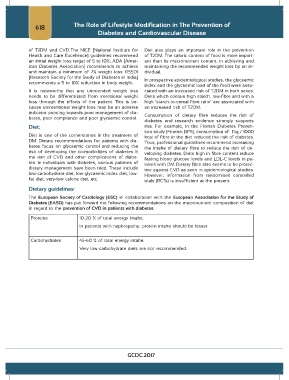
              The  European Society of Cardiology (ESC) in collaboration with the  European Association for the Study of
              Diabetes (EASD) has put forward the following recommendations on the macronutrient composition of diet
              in regard to the prevention of CVD in patients with diabetes:

               Proteins             10-20 % of total energy intake.
                                    In patients with nephropathy, protein intake should be lesser.


               Carbohydrates        45-60 % of total energy intake.

                                    Very low carbohydrate diets are not recommended.


                                                         GCDC 2017

