


Page 80 - fbkCardioDiabetes_2017
P. 80
56                           Cardio Diabetes Medicine 2017


                                                                 tion  according to the state of extremities and lungs
                                                                     (9)
               Syncope               Irregular pulse
                                                                 helps  in understanding the severity  of heart failure
               Trepopnoea            Tachypnoea
                                                                 and need for immediate action. Framingham devised
                                     Cheyne Stokes respiration   criteria   for recognising heart failure which includes
                                                                       (10)
                                     Hepatomegaly                distended neck veins, cold extremities, gallop rhythm
                                     Ascites                     or new onset murmur on cardiovascular system ex-
                                                                 amination, bilateral rales in the lungs, altered mental
                                     Cold extremities
                                                                 status,  hepatomegaly,  pedal  edema and/or  oliguria.
                                     Oliguria
                                                                 Other positive findings are tachycardia, narrow pulse
                                     Narrow pulse pressure       pressure,  S3 and S4  gallops  and murmurs of  mitral
                (Table 1) Symptoms And Signs of Cardiogenic Shock  and/or tricuspid regurgitation.
              The suddenness of onset of shock may help in look-  Critically ill patients have to be stabilized with respect
              ing for new onset causes of cardiogenic shock like   to securing  airway,  breathing  and circulation.  Early
              myocardial infarction  or myocarditis. History  of cor-  investigations should be directed to rule out obstruc-
              onary artery disease or acute coronary syndrome or   tive forms of cardiogenic shock like tension pneumo-
              pre-existing  cardiomyopathy  is  useful in delineating   thorax,  cardiac tamponade  or pulmonary embolism.
              the probable etiology of cardiogenic shock.        Initial blood investigations include arterial blood gas-
                                                                 es,  hemoglobin, cardiac troponins,  brain  natriuretic
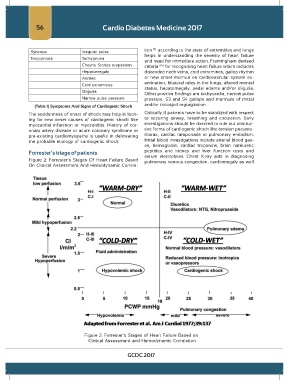
              Forrester’s triage of patients                     peptides  and kidney  and liver  function  tests  and
                                                                 serum electrolytes.  Chest X-ray aids in diagnosing
              Figure  2: Forrester’s  Stages  Of  Heart  Failure  Based   pulmonary venous congestion, cardiomegaly as well
              On Clinical Assessment And Hemodynamic Correla-


                                      Figure 2: Forrester’s Stages of Heart Failure Based on
                                        Clinical Assessment and Hemodynamic Correlation


                                                         GCDC 2017

