


Page 79 - fbkCardioDiabetes_2017
P. 79
Cardiogenic Shock:                                            55
                                 Etiopathogenesis & Clinical Recognition


                 in heart rate remains one of the first compensatory   Unless  the mesenteric  arteries  have  a pre-existing
                 mechanisms to maintain tissue perfusion and hence   stenosis  which may lead to mesenteric ischemia,
                 is an important clue to the onset of decompensation.  ischemic  necrosis  of the  intestines usually occurs
                                                                    late in the stages of irreversible shock.
                 Hypotension:  Primary  pump  failure  leads  to earlier
                 onset of hypotension in cardiogenic shock compared   Brain: Impaired perfusion to brain occurs as an end
                 to the other forms of shock. This is only one of the   result  of prolonged  or  severe  shock. This  leads  to
                 manifestations of  cardiogenic shock and other  fea-  cell death in the brain, cerebral edema, agitation, sei-
                 tures have to be sought for before making a diagno-  zures, obtundation and finally brain death. Hepatitis
                 sis of cardiogenic shock. Hypotension could be due   can also result in direct transmission of ammonia and
                 to hypovolemia or peripheral vasodilation (sepsis) or   other toxins to the brain resulting in hepatic coma.
                 drug induced. It is defined in adults by systolic blood   Lactic  acidosis: Tissue  hypoperfusion  throughout
                 pressure  < 90mmhg,  mean arterial  blood pressure   the body leads to intracellular accumulation of lactic
                 <65mmhg or relative drop in systolic BP>40mmhg.
                                                                    acid and eventually results in lactic acidosis. The det-
                 Skin:  Peripheral vasoconstriction is  an important   rimental  effects  of  acidosis  include endothelial  cell
                 compensatory mechanism  for  cardiogenic shock.    death and failure of peripheral vasoconstriction and
                 Cold, clammy extremities  are  a  result  of  this mech-  fall in peripheral vascular resistance, further depres-
                 anism. Prolonged  vasoconstriction,  compounded by   sion  of  myocardial contractility,  elevation of  pulmo-
                 intravenous vasopressors, has known to result in dig-  nary arterial pressures and impaired responsiveness
                 ital gangrene. Backward failure of right heart leads to   to the parenteral medications.
                 congested veins and  elevated jugular venous  pulse   History and clinical examination can result in a rea-
                 and pressure in the neck which serve as an important   sonable recognition of cardiogenic shock.
                 diagnostic clue to raised right heart pressures.
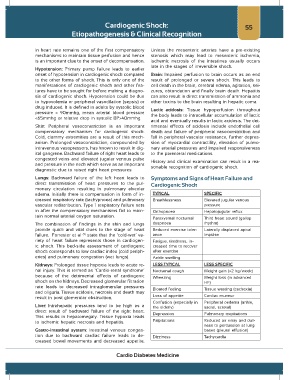
                 Lungs: Backward failure of the  left heart leads to  Symptoms and Signs of Heart Failure and
                 direct  transmission  of  heart pressures  to the pul-  Cardiogenic Shock
                 monary circulation resulting in pulmonary alveolar
                 edema. Initially there is compensation in form of in-  TYPICAL            SPECIFIC
                 creased respiratory rate (tachypnoea) and pulmonary   Breathlessness      Elevated jugular venous
                 vascular redistribution. Type 1 respiratory failure sets                  pressure
                 in after the compensatory mechanisms fail to main-  Orthopnoea            Hepatojugular reflux
                 tain normal arterial oxygen saturation.
                                                                    Paroxysmal nocturnal   Third heart sound (gallop
                 The combination  of findings  in the skin  and lungs   dyspnoea           rhythm)
                 provide  quick  and vital clues  to the stage  of  heart   Reduced exercise toler-  Laterally displaced apical
                                      (9)
                 failure.  Forrester et al   state that the ‘cold-wet’ va-  ance           impulse
                 riety  of heart failure  represents those in cardiogen-  Fatigue, tiredness, in-
                 ic shock.  This bed-side  assessment of cardiogenic   creased time to recover
                 shock corresponds to low cardiac index (cold periph-  after exercise
                 eries) and pulmonary congestion (wet lungs).       Ankle swelling
                 Kidneys: Prolonged tissue hypoxia leads to acute re-  LESS TYPICAL        LESS SPECIFIC
                 nal injury. This is termed as ‘Cardio-renal syndrome’   Nocturnal cough   Weight gain (>2 kg/week)
                 because of the detrimental effects of cardiogenic   Wheezing              Weight loss (in advanced
                 shock on the kidneys. Decreased glomerular filtration                     HF)
                 rate leads to decreased  intraglomerular  pressures   Bloated feeling     Tissue wasting (cachexia)
                 and oliguria. Tissue acidosis, necrosis and death may
                 result in post glomerular obstruction.             Loss of appetite       Cardiac murmur
                                                                    Confusion (especially in   Peripheral oedema (ankle,
                 Liver:  Intrahepatic  pressures  tend to be high as a   the elderly)      sacral, scrotal)
                 direct result  of backward failure  of the right  heart.
                 This  results  in hepatomegaly.  Tissue  hypoxia  leads   Depression      Pulmonary crepitations
                 to ischemic hepatic necrosis and hepatitis.        Palpitations           Reduced air entry and dull-
                                                                                           ness to percussion at lung
                 Gastro-intestinal  system:  Intestinal  venous conges-                    bases (pleural effusion)
                 tion due to backward cardiac  failure  leads  to de-  Dizziness           Tachycardia
                 creased  bowel  movements and decreased  appetite.


                                                    Cardio Diabetes Medicine

