


Page 47 - Scientech_2018-19
P. 47
Aryabhata wrote that 1,582,237,500 rotations of the Earth equal 57,753,336 lunar orbits. This
        is an extremely accurate of a fundamental astronomical ratio (1,582,237,500/57,753,336 =
        27.3964693572), and is perhaps the oldest astronomical constant calculated to such accuracy.
        Brahmagupta (598-668) was the head of the astronomical observatory at Ujjain and during
        his tenure there wrote a text on astronomy, the Brahmasphutasiddhanta.

        Bhaskara (1114-1185) was the head of the astronomical observatory at Ujjain, continuing the
        mathematical tradition of Brahmagupta. He wrote the Siddhantasiromani which consists of
        two parts: Goladhyaya (sphere) and Grahaganita (mathematics of the planets).


        Early cultures identified celestial objects with gods and spirits. They related these objects
        (and their  movements)  to phenomena such as rain,  drought, seasons, and tides.  It  is
        generally believed that the first “professional” astronomers were priests (Magi), and that their
        understanding of the “heavens” was seen as “divine”, hence astronomy’s ancient connection
        to what is now called astrology. Ancient constructions with astronomical alineations (such as
        Stonehenge) probably fulfilled both astronomical and religious functions.


        Calendars of the world have usually been set by the Sun and Moon (measuring the day, month
        and year), and were of importance to agricultural societies, in which the harvest depended
        on planting at the correct time of year. The most common modern calendar is based on the
        Roman calendar, which divided the year into twelve months of alternating thirty and thirty-
        one days apiece. In 46 BC Julius Caesar instigated calendar reform and created the leap year.
        There are  astronomical  references  of  chronological  significance  in  the  Vedas. Some Vedic
        notices mark the beginning of the year and that of the vernal equinox in Orion - this was
        the case around 4500 BC. Fire altars, with astronomical basis, have been found in the third
        millennium cities of India. The texts that describe their designs are conservatively dated to the
        first millennium BC, but their contents appear to be much older.

        Yajnavalkya (perhaps 1800 BC) described the motions of the Sun and the Moon in his book
        Shatapatha Brahmana, and also advanced a 95-year cycle to synchronize the motions of the
        Sun and the Moon.

        In Indian languages, the science of astronomy is called Khagola-shastra. The word Khagola
        perhaps is derived from the famous astronomical observatory at the University of Nalanda
        which was called Khagola. It was at Khagola that the famous 5th century Indian Astronomer
        Aryabhatta studied and extended the subject.

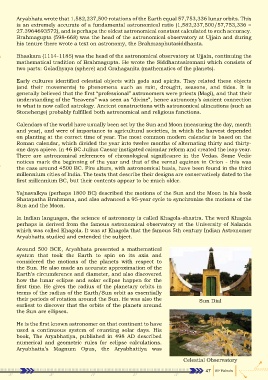
        Around  500  BCE,  Aryabhata  presented  a  mathematical
        system  that  took  the  Earth  to  spin  on  its  axis  and
        considered the motions of the planets with  respect to
        the Sun. He also made an accurate approximation of the
        Earth’s circumference and diameter, and also discovered
        how the lunar eclipse and solar eclipse happen for the
        first time. He gives the radius of the planetary orbits in
        terms of the radius of the Earth/Sun orbit as essentially
        their periods of rotation around the Sun. He was also the
        earliest to discover that the orbits of the planets around
        the Sun are ellipses.


        He is the first known astronomer on that continent to have
        used a continuous system of counting solar days. His
        book, The Aryabhatiya,  published in  498 AD  described
        numerical  and geometric  rules  for  eclipse  calculations.
        Aryabhatta’s Magnum  Opus,  the  Aryabhattiya was


 SIF Bahrain                                                                                47   SIF Bahrain

