


Page 51 - Scientech_2018-19
P. 51
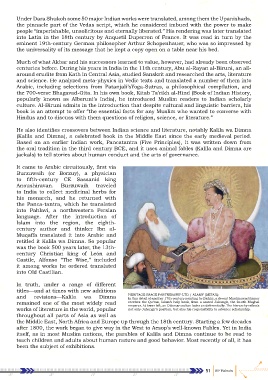
Under Dara Shukoh some 50 major Indian works were translated, among them the Upanishads,
        the pinnacle part of the Vedas script, which he considered imbued with the power to make
        people “imperishable, unsolicitous and eternally liberated.” His rendering was later translated
        into Latin in the 18th century by Anquetil Duperron of France. It was read in turn by the
        eminent 19th-century German philosopher Arthur Schopenhauer, who was so impressed by
        the universality of its message that he kept a copy open on a table near his bed.

        Much of what Akbar and his successors learned to value, however, had already been observed
        centuries before. During his years in India in the 11th century, Abu al-Rayan al-Biruni, an all-
        around erudite from Kath in Central Asia, studied Sanskrit and researched the arts, literature
        and science. He analyzed meta-physics in Vedic texts and translated a number of them into
        Arabic, including selections from Patanjali’sYoga-Sutras, a philosophical compilation,  and
        the 700-verse Bhagavad-Gita. In his own book, Kitab Ta’rikh al-Hind (Book of Indian History,
        popularly known as Alberuni’s India),  he introduced Muslim  readers to Indian scholarly
        culture. Al-Biruni admits in the introduction that despite cultural and linguistic barriers, his
        book is an attempt to offer “the essential facts for any Muslim who wanted to converse with
        Hindus and to discuss with them questions of religion, science, or literature.”

        He also identifies crossovers between Indian science and literature, notably Kalila wa Dimna
        (Kalila and Dimna), a celebrated book in the Middle East since the early medieval period.
        Based on an earlier Indian work, Pancatantra  (Five Principles), it was written down from
        the oral tradition in the third century BCE, and it uses animal fables (Kalila and Dimna are
        jackals) to tell stories about human conduct and the arts of governance.

        It came to Arabic circuitously, first via
        Burzuwaih  (or  Borzuy),  a physician
        to  fifth-century  CE  Sassanid  king
        Anoushiravan.       Burzuwaih       traveled
        to  India  to  collect  medicinal  herbs for
        his  monarch, and he  returned with
        the Panca-tantra, which he translated
        into Pahlavi, a northwestern Persian
        language. After  the  introduction of
        Islam into the region, the eighth-
        century author  and thinker  Ibn  al-
        Muqaffa translated it  into Arabic and
        retitled it Kalila wa Dimna. So popular
        was the book 500 years later, the 13th-
        century Christian  king of  León and
        Castile, Alfonso  “The  Wise,” included
        it  among works he ordered translated
        into Old Castilian.


        In truth, under a range of different
        titles—and at times with new additions
        and     revisions—Kalila      wa     Dimna
        remained one of the most widely  read
        works of literature in the world, popular
        throughout all parts of Asia as well as
        the Middle East, North Africa and Europe up through the 18th century. Starting a few decades
        after 1800, the work began to give way in the West to Aesop’s well-known Fables. Yet in India
        itself, as in most Muslim nations, the parables of Kalila and Dimna continue to be read to
        teach children and adults about human nature and good behavior. Most recently of all, it has
        been the subject of exhibitions.


 SIF Bahrain                                                                                51   SIF Bahrain

